Warning: This post is a potential emunah threat. This post is not for small children or naïve people from Lakewood. If you have no doubt that all of Breishis is literally true, then you can read on, because clearly nothing anyone says is ever going to affect your emunah in any way. On the other hand, if you have been persuaded that Breishis is not quite literally true, but think Shemos is fine, then maybe you should go read Hirhurim or Cross Currents instead. This post is only for those who already have doubts about Shemos.
Clearly, it would be remiss not to talk about Shemos. I have been putting it off for a number of reasons, including:
• I am not as fluent in history and archeology as I am in basic science
• It’s much more fun to argue about global floods and dinosaurs
• The stakes are way too high in Shemos
But we can’t put it off any longer. Last week, Rabbi Neil Gillman’s ‘dvar torah’ in the Jewish Week basically laid out the skeptical approach to Shemos: There is some basic element of truth to it, but as the story got retold and retold over the generations the facts became rather exaggerated'. I guess that’s what most Conservative Jews hold, but as Mis-nagid says, Joseph Smith probably did wear a hat, so that view of hisory isn't very useful.
So, let’s investigate the issues with Shemos. First, let’s discuss them purely objectively from an impartial perspective, and at the end we’ll talk about Faith. The basic assumption for this discussion is that God exists and that He interacts with the world. If you are an atheist or a deist, then clearly the key religious elements of Shemos are not possible, whether the rest of it is historically accurate or not.
There are five main topics to discuss:
1. The Plagues
2. The Escape of 2 million people
3. Kriyat Yam Suf & Other Miracles (Man etc)
4. Revelation at Sinai
5. Conquest of Canaan
(Yes, I know the conquest is not in Shemos, but we might as well address it now.)
1. The Plagues
There have been numerous attempts to explain the plagues in a naturalistic way. Indeed, the plagues themselves are mostly the typical kind of thing you get in Egypt, and even the ones that aren’t, can seemingly be explained fairly simply. For example, the Nile turns red each year due to algae, so maybe ‘dam’ means blood red rather than actual blood. Most explanations falter at the last plague, but I have even seen a naturalistic explanation for that too. For a believer in God though, the issue with the plagues is not so much how they could have happened, but whether history records them as having happened. We have no problems with miracles, as long as the miracle is as recorded in the Torah, and you don’t have to invent a bunch of very strange ‘after the fact’ miracles to explain away the total lack of evidence, or even opposing evidence, as with the flood. So, is it feasible that these plagues happened to Egypt and left no evidence? There is the famous ‘Ipuwer Manuscript’ which seems to talk about the plagues, and it is understandable that the Egyptians did not write about them much. Plus, the plagues would not really have left much geological or archeological evidence.
In summary, the emunah threat from the plagues is (relatively) low. You could go with either a naturalistic explanation or a miraculous one, and be okay.
2. The Escape
The Torah recounts that all the Bnei Yisrael, including an Erev Rav escaped from Egypt. Shortly afterwards the Torah counts the males as being about 600,000, which would imply a total population of around 2 million. This means that about 2 million people (ex slaves + hangers on) left Egypt suddenly. This is highly unlikely. First of all, this would have been a gigantic number by the standards in those days. The entire global population was much less than today. Secondly the movement of such a large number of people strains credibility. The Torah mentions many miracles, but it does not seem to imply that the movement of 2 million people out of Egypt is one of them. Even worse, such a gigantic event would surely have been recorded somewhere (besides the Torah), yet there is no trace of this anywhere else in recorded history
There is really no good way around this problem. From a rational perspective, the Torah’s account here is not very credible.
In summary: Emunah Threat very high
3. Kriyat Yam Suf & Other Miracles
I don’t really see any problems here, apart from the impossible numbers. God can do miracles if He wants to. There are also naturalistic explanations for the kriyat yam suf, the manna, and most of the other miracles too, though that approach would still require you to kvetch the text rather a lot.
In summary: Emunah Threat medium.
4. Revelation at Sinai
For a believer in God, it seems natural to assume that God could and maybe would communicate with His creation. Or, at the very least, would enable His creation (i.e. man) to intuit or become Divinely Inspired to figure out the goal in life, and the way to reach that goal. The story of Sinai does sound like a typical volcanic eruption story though, which is a little troubling. Then again, none of the other volcano stories finished up with the 10 commandments being given, so that was definitely a first.
In summary: Emunah Threat low.
5.Conquest of Canaan
Archeological evidence does not corroborate the Torah’s account of a massive invasion and conquest of Canaan. Archeologists debate about how much truth there is to the Biblical account, but as the Torah’s numbers are impossible anyway from a rational perspective, nobody takes a huge scale invasion of 2 million people very seriously. The evidence here seems to be strong, but archeology is kinda fuzzy, plus the full details of the conquest are in Nach, not the Torah, so I’ll just rate this one a low emunah threat.
Summary
Overall the shemos story loses credibility for two primary reasons:
1. The number of people involved is in itself not credible, considering population sizes at that time and the issues surrounding moving 2 million people quickly out of Egypt.
2. The scale and magnitude of the events would have left some record somewhere, in either archeological or other historical documents. There is none. The Torah and even more so the Midrashim only make this problem worse by implying that the whole world knew of these events. Maybe you can say Egyptians didn’t record anything because they had been defeated, but why didn’t any other nations record something?
Approaches
There are a number of approaches to these problems, mostly pretty similar to the approaches in Breishis, but with some twists.
1. Ness/Nissayon
Everything in this story that is not explainable by (or is in conflict with) Science, Archeology, History etc. was/is a Ness and a Nissayon. This doesn’t work as well here as in Breishis, since with Breishis the Ness/Nissayonists have some slight crutches to lean on – the Gemarah that Adam was created fully formed, the notion that the Mabul waters were ‘magical’ and thus didn’t leave normal traces. With Shemos however, why would there be no evidence of such a monumental set of events? Did Hashem remove all traces of documentation or whatever davkah as a nIssayon? Seems very strange.
2. Myth/Moshol
We can say that all these events, whilst having a kernel of truth are basically mythology. However this is very difficult. While it may be acceptable in Breishis, it’s much harder to say this in Shemos, since the Torah was supposedly given right after these events occurred, so the Bnei Yisrael would surely have know what actually happened. How would they have accepted a mythological/moshological account of the current events? Unless they knew it to be exaggerated and they didn’t mind. Not a very credible peshat here, unless you say the Torah was written many years later, when people had forgotten the original events. Of course this doesn’t do much good for the Kiruv Clown Kuzari Proof.
3. Kiruv/Kvetch
The kvetchers would say that we can take the account non literally in places. For example, some people say that ‘eleph’ in the census does not mean thousand, but instead means a family clan, or maybe an army troop. Kvetching actually works better in Shemos than it does in Breishis. I am strongly opposed to the whole ‘local flood’ theory in Breishis, since that is clearly not the sense of the Noach story. A story about a man, a small boat, some pets and a local flood is not the story of the Mabul. However in Shemos it’s a bit different. A story about 20,000 slaves escaping from Egypt and then having a revelation from God at Sinai is still one heck of a story. So while kvetching would seem to be somewhat disingenuous, it doesn’t do as much violence to the overall story here.
Conclusion
There is of course much more to be said on this subject. From a rational perspective, the story in Shemos is not credible, by normal standards that we all use in other areas of every day life. It’s not just a problem of absence of evidence. Clearly, the absence of evidence is enough here to be counted as evidence of absence. The big question is, how strong is the evidence against the story? Strong enough to counter faith or not strong enough? The answer to this question will be different for each person.
My own point of view is that I will have faith as long as there is not hard evidence against it. I think there is hard evidence against the 2 million number, and so I cannot really accept that at this current time. Once you downsize the numbers, the problem of lack of evidence goes away, since a small escape would not have had global ramifications. The rest of the story (miracles etc) is basically okay (with a few tweaks). Of course the text still has to be dealt with. What I do with the text is the subject of another post. (Hint: It’s not kiruv kvetch.)
Mussar Shmmoze
I would like to end off this piece of skeptical thinking with a mussar shmooz.
Rabbosai, the Ribbono shel Olom put us on this Earth for a reason. We may not have all the answers, and everything may not add up. But if God exists (and we believe it’s likely that He does), then it’s unlikely He just created us and walked away. This implies that He is watching and listening to everything that goes on over here, or at least He might be. Imagine if you really, really felt this. I mean really, really, really felt this. Could you be mevatel even one second? Could you be rude even one time to your spouse, or to your parents? Could you do one averah? Even if you are an agnostic or weak atheist, if this really was a possibility could you possibly ignore it? I don’t think so. In fact, if you really, really, really, really felt it, you would probably be paralyzed with fear and wouldn’t be able to do anything at all, never mind any aveiros. As many even very frum yidden are quite comfortable doing at least some aveiros, it’s clear that very few people even amongst the maaminim really feel God’s presence, certainly not all the time. May it be God’s will that we feel His presence, if not all the time, at least some of the time.
Showing posts with label Archeology. Show all posts
Showing posts with label Archeology. Show all posts
Sunday, February 19, 2006
Monday, September 19, 2005
'Better' DNA out of fossil bones
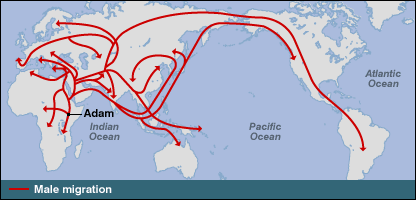
Map shows first migratory routes taken by humans, based on surveys of different types of the male Y chromosome. "Adam" represents the common ancestor from which all Y chromosomes descended
Neanderthals evolve about 250,000 years ago
Their range extends from Europe to Central Asia and the Middle East
Modern humans leave Africa about 60,000 years ago and arrive in Europe around 40,000 years ago
By 27,000 years ago, the Neanderthals are extinct
Possible reasons include climate change and competition with modern humans
Research based on DNA testing of 10,000 people from indigenous populations around the world
Source: The Genographic Project
By Alison Ross
BBC News
Improved technologies for extracting genetic material from fossils may help us find out more about our ancient ancestors.
Scientists in Israel have just developed a new technique to retrieve better quality, less contaminated DNA from very old remains, including human bones. It could aid the study of the evolution and migration of early modern humans, as well as extinct populations such as our close relatives, the Neanderthals.
Many researchers would dearly love to get their hands on DNA samples from hominids further back in time - from those that lived 100,000 years ago or more - to find out how they were related to people alive today.
But fossil studies this far back in time have long been hindered by contamination with foreign genetic material and the problem of recovering long, intact DNA sequences.
The new method provides hope, however.
What's real?
"DNA gets everywhere. So when we're dealing with a sample and you find it's got human DNA in it - is that DNA from the fossil, or is it actually DNA from the person who unearthed it?" says Professor Chris Stringer, the head of human origins at the Natural History Museum in London, UK.
Also, DNA falls apart over the course of time. "It breaks up into very small fragments so it is quite technically complicated to put it all back together again," explains Dr Robert Foley, the director of the Leverhulme Centre for Human Evolutionary Studies at the University of Cambridge, UK.
Freezing provides the ideal preservation conditions. The most widely accepted oldest DNA yet isolated comes from 400,000-year-old plants found in ice in Siberia. But most specimens are not excavated from such places.
An improved technique for retrieving DNA from fossil bone, just published in the journal Proceedings of the National Academy of Sciences (PNAS), may help.
Dr Michal Salamon, from the Weizmann Institute of Science in Rehovot, Israel, and colleagues, showed that "crystal aggregates", small mineral pockets formed during fossilisation, can preserve DNA better than the rest of the bone.
They compared DNA extracted from these crystal aggregates with genetic material taken from untreated, whole-bone powder. The samples were taken from eight different modern and fossil bones.
They found better preserved, less contaminated DNA could be recovered from the isolated crystals. This approach, "significantly improves the chances of obtaining authentic ancient DNA sequences, especially from human bones", they told PNAS.
Commenting on the latest research, Dr Michael Hofreiter, from the Max Planck Institute for Evolutionary Anthropology in Leipzig, Germany, who helped decode 40,000-year-old nuclear DNA from a cave bear earlier this year, said: "It's possible; but there need to be more studies on more samples, and they need to show that you don't get human contamination of animal bones.
"Then I would believe that it is a breakthrough for ancient DNA research."
The big split
Scientists are hopeful the new technique will help them get at the DNA in the chromosomes of a cell - the nuclear DNA.
Ancient DNA research has so far mainly focused on mitochondria, the tiny "power-stations" of the cell. These exist outside of the nucleus and have their own DNA. And, although this information is very useful, it is more limited in its scope than that which could be obtained from nuclear DNA.
It is partly a question of sensitivity. "There's about 1,000 times more mitochondrial DNA than nuclear DNA in our cells, so it's much easier to pick up," explains Professor Stringer.
The mitochondrial DNA is inherited only through the egg - through females. This means it is a useful marker for tracing a line back into the past, as it has never been mixed with DNA from males.
"One of the most important discoveries from studying ancient mitochondrial DNA is the estimate of when humans diverged in evolution from the Neanderthals - around half a million years ago," according to Dr Foley.
Professor Stringer adds: "We've now got about 10 Neanderthal specimens of around 40-50,000 years old that have yielded DNA that is clearly distinct from anyone alive today."
This means scientists can be sure that it is ancient, not just modern DNA from contamination. It has also given them a measure of how different Neanderthals were from modern people. Neanderthals are three times as different from us as we all are from each other," says Professor Stringer.
Species debate
But there remains the hotly debated question of whether Neanderthals were a completely separate species to us. Professor Stringer says that they are if that assessment is based on studying their bone anatomy.
However, the evidence from mitochondrial DNA is somewhat ambiguous. "The mitochondrial DNA on its own can't tell us if we're a distinct species," he explains. "It depends what mammal you take. There are some species where the difference in mitochondrial DNA between us and Neanderthals would say they were a different species. "Whereas in chimpanzees, our closest relative, you could contain the variation between us and Neanderthals in a single species alive today in Africa."
Scientists need to recover better DNA from our fossils, especially the nuclear DNA. "Each gene has a separate evolution so to understand Neanderthals properly we will need different bits of their DNA to see if they're all telling us the same story," he adds.
Population movements
The male sex chromosome (the "Y") is useful for tracking male inheritance, since males inherit their Y chromosome only from their father.
Using both mitochondrial and Y chromosome DNA from people alive today, complex pathways have been mapped for how modern humans got to where they are - but there are problems.
Dr Mim Bower, an ancient DNA researcher at the McDonald Institute for Archaeological Research in Cambridge, UK, gives an example.
"Using modern DNA we see a different pattern of settlement in the Pacific islands between men and women - the mitochondrial DNA patterns show a different migration pattern to the Y chromosome DNA."
Studying the DNA not of modern humans but of their distant ancestors could help answer such questions.
"At the moment we can't follow that into the past as it's very difficult to get nuclear DNA," Dr Bower says.
This is especially problematic for the Y chromosome, which is nuclear.

Subscribe to:
Posts (Atom)