I saw a funny comment on Hirhurim today. Dilbert wrote, regarding R Carmy’s rather vague article on Science & Torah:
Rabbi Carmy's editorial was disappointing to me on a number of fronts. I have long been an admirer of his, but this editorial was long on verbage, and short on substance. I don’t have it in front of me to quote specifically, but basically he wrote that he didn't agree with the ban, but understood and empathized with the rationale behind it. Even worse was his admission that he was not totally familiar with the specifics of the bans, not having read them all.
I would have hoped that the editor of the pre-eminent English language journal of Modern orthodox thought would have roused himself to a stirring defense of science co-existing with Torah. At the very least, defending the hashkafa that using science is a religiously valid view point. Or maybe even opining on the process by which the bans appeared. He did none of those. Instead, he basically said that one shouldn't think too hard about the difficulties that science poses, and that he understands, if not agrees with the motive to suppress these opinions. It was VERY disappointing.
Wow. Maybe R Carmy is smarter than I thought? No stirring defense of Science AND Torah? One shouldn’t think too hard about this stuff? Maybe R Carmy has been reading Not The Godol Hador!
It’s funny how my opinions have changed 180 degrees since last year. Originally I saw the Science & Torah reconciliation people as the guys with the answers. Now I realize that they have no clue. At best all they are really doing is trying to keep Orthodoxy open to the full range of Rishonim (which is not a bad thing in itself). Unfortunately all the Rishonim in the world aren’t going to help you with reconciling modern Science with Breishis, since the two stories are fundamentally different, and I don’t recall seeing any Rishonim say that Breishis 1-11 is mythology, or even that the Mabul was (gasp!) local. Dilbert, Y Aharon, Harry Maryles, Gil, Rabbi Slifkin and all the other ‘Science is okay!’ types are simply not facing reality. They want to have their cake and eat it, but it can’t happen. In fact, they seem to be as much about avoiding reality as the Chareidim are.
You guys want to accept modern science? Then it’s goodbye Orthodox Judaism, at least as currently defined. You have the cojones like R Louis Jacobs zt"l to go redefine Orthodoxy? No, I didn’t think so. So what do you expect? The Chareidim are unfortunately correct – modern Science IS incompatible with Orthodoxy, from any plausible viewpoint. Unless you want to tell me that Myth/Moshol is 100% A-OK? No, I didn’t think so. Oh wait, you have faith that the answers are out there, we just haven't found them yet.
Sure! Could be, could be.
Showing posts with label Science and Torah. Show all posts
Showing posts with label Science and Torah. Show all posts
Wednesday, July 5, 2006
Wednesday, June 7, 2006
Proof for Judaism?
Seems that my last few posts got a lot of people rather upset, especially the way I just took it for granted that there’s no good evidence for religion, and our beliefs in religion are based entirely on faith (a.k.a. wishful thinking).
So why did I come to this conclusion? Didn’t I myself spend many months arguing with the skeptics, and writing mega chizuk posts which contained all sorts of arguments proving Judaism and the existence of God? Yes, I did. But ultimately I found my opponents arguments more convincing than my own.
However, you may decide differently. In the interests of fairness, I will present all those arguments again (in summary form only), together with their counter-arguments, and you can be the judge which is more plausible.
1. The Mesorah Proof
Argument
The beliefs of Judaism have been passed down father to son for three thousand years, in an unbroken and traceable chain of tradition. We know our fathers wouldn’t lie to us, therefore it must be true.
Counter Argument
Many (conflicting) religious traditions are passed down father to son, yet are untrue. Parents don’t deliberately lie, however people can be misled, and myths grow over time. To claim that the great Gedolim of each generation passed these beliefs down so they must be true is circular reasoning: If the beliefs are not true then the great Gedolim are not so great.
2. The Sinai Proof
Argument
Judaism is the only religion to claim a mass revelation, i.e. Sinai in front of 2.5 million Jews. How could anyone make such a story up, and convince people it happened to their ancestors? And if it was possible to make up such a grand story, how come no other religion tried to do this, but only have revelation stories in front of a small group of people?
Counter Argument
It’s true that Sinai is a fairly unique claim. However myths form over many centuries, and it’s entirely possible that the claim grew over the years. We don’t know why other religions didn’t try the same claim, but that’s no proof of anything, except for the fact that the Jewish claim is the most audacious. Also, claims of miracles tend to decrease over the millennia, as people get wiser and less superstitious. Possibly 3,000 years ago you could make a mass revelation claim, 2,000 years ago you could make a resurrection claim, and 500 years ago you could make a Maggid claim. Nowadays you can’t even claim a talking fish without Rabbi Adlerstein publicly announcing his skepticism.
3. The Brilliant Talmud / Rishonim / Acharonim Proof Type A
Argument
Once you see the brilliance of the Gemarah / Rishonim / R Akiva Eiger, you will see how such a system can only be divine.
Counter
None of this is all that brilliant, it’s just years of complexity added upon complexity, creating a confusing mess which finely trained minds like to ponder. Objectively speaking, Science is way more brilliant and profound. Only people brainwashed in the system think it’s so brilliant. Muslims think the Koran is mindblowing too, and Mormons think the Book of Mormon is incredible.
4. The Brilliant Talmud / Rishonim / Acharonim Proof Type B
Argument
Chazal / Rishonim / R Akiva Eiger / R Moshe were all amazingly brilliant people. They believed in Judaism, so it must be true.
Counter Argument
Smart people exist in every faith. Smart people are good at justifying their childhood indoctrinated beliefs with smart aguments. Some very smart people throughout history believed some very strange things. There are plenty of smart religious people in Christianity and Islam too.
5. The History Proof
Argument
Jewish history is unique. We have survived thousands of years, incredible persecutions, we are always on the news, and we are a tiny percentage of the world’s population. In addition our contribution to society and effect on civilization has been amazing. All this has been noted with wonder by many people (including quite a few anti-semites) over the last two thousand years. Our survival and success is inexplicable, God is the only answer.
Counter Argument
Jewish history is unique, but so is many other people’s history, in other ways. We have survived many adverse circumstances, but a combination of culture, laws, non integration into society and other factors can explain our survival. Also our emphasis on education has paid enormous dividends. Our survival can be explained in natural ways.
6. The Experience Proof
Argument
Once you experience Shabbos (or Learning, or Kugel) you will see that it must be true.
Counter Argument
All religions offer great experiences, as do drugs and alcohol. Experiential emotions prove nothing, except that whatever you are experiencing has the power to create deep emotions.
7. The God Proof
Argument
We can prove there must be a First Cause i.e. God. Judaism was the first religion to promote this idea, and it has since spread worldwide. God would want us to know about Him and his mission, therefore it makes sense that Judaism is the one true religion. Also, all the other religions are just derivative of Judaism, or else don’t make any major claims about God at all, or are just idolatry. Judaism is the original and still the only pure monotheistic faith.
Counter Argument
God’s existence has not been sufficiently proven. Even if you hold it has, it doesn’t follow that Judaism is from God. Jews may have intuited God’s existence correctly, but the rest of the religion could be man made. God might even be displeased with the religion, for focusing on the wrong things, and incorrectly claiming unique status.
8. The Halachah Proof
Argument
Halachah works amazingly well to create decent people and communities, and always has done. Such an effective system can only have come from God.
Counter Argument
Only religious Jews are convinced that religious Jews are so great. Everyone else sees a community like any other, possibly with lower crime levels and stronger family ties, but that is easily explainable sociologically. Plus when you factor in the increased racism and intolerance, and all the other problems endemic in Chareidi society, including behavior of the Gedolim, it doesn't look so great.
9. The Prophecy Proof
Argument
The Torah correctly foretells the various churbanot and tragedies. It must be true.
Counter Argument
Depends when it was written. If it was written during or after the first churban, this is not so amazing. Could also be a lucky guess, many ANE texts contain dire warnings and curses.
10. The Discovery Proofs
Argument
Various clever and non intuitive proofs involving codes, the shmittah year, camels & hyraxes or whatever.
Counter Argument
Most (all?) of these don’t really work if you look into them. Others are just sophistry.
11. The Convergence Proof
Argument
While none of the above taken by themselves are strong enough proof, when you add them all together it tells a very powerful story. The original monotheistic religion survives against all odds, has many prophecies fulfilled, makes an incredible contribution to society and is still front page news 3,000 years later. So amazing it can only mean one thing. It’s all true.
Counter Argument
None of these proofs on their own amount to anything. Zero plus zero is still zero. There’s nothing here.
Conclusion
Personally I do actually find a few of these somewhat convincing, and taken all together they do tell a good story, certainly a better story than all the other religions.
But is that proof enough?
In my next post I will present a summary of all the proofs against Judaism, together with their counter arguments. Then we can judge which set of proofs are more convincing, all from a strictly rational perspective of course. If you have faith, then none of this is in any way relevant.
So why did I come to this conclusion? Didn’t I myself spend many months arguing with the skeptics, and writing mega chizuk posts which contained all sorts of arguments proving Judaism and the existence of God? Yes, I did. But ultimately I found my opponents arguments more convincing than my own.
However, you may decide differently. In the interests of fairness, I will present all those arguments again (in summary form only), together with their counter-arguments, and you can be the judge which is more plausible.
1. The Mesorah Proof
Argument
The beliefs of Judaism have been passed down father to son for three thousand years, in an unbroken and traceable chain of tradition. We know our fathers wouldn’t lie to us, therefore it must be true.
Counter Argument
Many (conflicting) religious traditions are passed down father to son, yet are untrue. Parents don’t deliberately lie, however people can be misled, and myths grow over time. To claim that the great Gedolim of each generation passed these beliefs down so they must be true is circular reasoning: If the beliefs are not true then the great Gedolim are not so great.
2. The Sinai Proof
Argument
Judaism is the only religion to claim a mass revelation, i.e. Sinai in front of 2.5 million Jews. How could anyone make such a story up, and convince people it happened to their ancestors? And if it was possible to make up such a grand story, how come no other religion tried to do this, but only have revelation stories in front of a small group of people?
Counter Argument
It’s true that Sinai is a fairly unique claim. However myths form over many centuries, and it’s entirely possible that the claim grew over the years. We don’t know why other religions didn’t try the same claim, but that’s no proof of anything, except for the fact that the Jewish claim is the most audacious. Also, claims of miracles tend to decrease over the millennia, as people get wiser and less superstitious. Possibly 3,000 years ago you could make a mass revelation claim, 2,000 years ago you could make a resurrection claim, and 500 years ago you could make a Maggid claim. Nowadays you can’t even claim a talking fish without Rabbi Adlerstein publicly announcing his skepticism.
3. The Brilliant Talmud / Rishonim / Acharonim Proof Type A
Argument
Once you see the brilliance of the Gemarah / Rishonim / R Akiva Eiger, you will see how such a system can only be divine.
Counter
None of this is all that brilliant, it’s just years of complexity added upon complexity, creating a confusing mess which finely trained minds like to ponder. Objectively speaking, Science is way more brilliant and profound. Only people brainwashed in the system think it’s so brilliant. Muslims think the Koran is mindblowing too, and Mormons think the Book of Mormon is incredible.
4. The Brilliant Talmud / Rishonim / Acharonim Proof Type B
Argument
Chazal / Rishonim / R Akiva Eiger / R Moshe were all amazingly brilliant people. They believed in Judaism, so it must be true.
Counter Argument
Smart people exist in every faith. Smart people are good at justifying their childhood indoctrinated beliefs with smart aguments. Some very smart people throughout history believed some very strange things. There are plenty of smart religious people in Christianity and Islam too.
5. The History Proof
Argument
Jewish history is unique. We have survived thousands of years, incredible persecutions, we are always on the news, and we are a tiny percentage of the world’s population. In addition our contribution to society and effect on civilization has been amazing. All this has been noted with wonder by many people (including quite a few anti-semites) over the last two thousand years. Our survival and success is inexplicable, God is the only answer.
Counter Argument
Jewish history is unique, but so is many other people’s history, in other ways. We have survived many adverse circumstances, but a combination of culture, laws, non integration into society and other factors can explain our survival. Also our emphasis on education has paid enormous dividends. Our survival can be explained in natural ways.
6. The Experience Proof
Argument
Once you experience Shabbos (or Learning, or Kugel) you will see that it must be true.
Counter Argument
All religions offer great experiences, as do drugs and alcohol. Experiential emotions prove nothing, except that whatever you are experiencing has the power to create deep emotions.
7. The God Proof
Argument
We can prove there must be a First Cause i.e. God. Judaism was the first religion to promote this idea, and it has since spread worldwide. God would want us to know about Him and his mission, therefore it makes sense that Judaism is the one true religion. Also, all the other religions are just derivative of Judaism, or else don’t make any major claims about God at all, or are just idolatry. Judaism is the original and still the only pure monotheistic faith.
Counter Argument
God’s existence has not been sufficiently proven. Even if you hold it has, it doesn’t follow that Judaism is from God. Jews may have intuited God’s existence correctly, but the rest of the religion could be man made. God might even be displeased with the religion, for focusing on the wrong things, and incorrectly claiming unique status.
8. The Halachah Proof
Argument
Halachah works amazingly well to create decent people and communities, and always has done. Such an effective system can only have come from God.
Counter Argument
Only religious Jews are convinced that religious Jews are so great. Everyone else sees a community like any other, possibly with lower crime levels and stronger family ties, but that is easily explainable sociologically. Plus when you factor in the increased racism and intolerance, and all the other problems endemic in Chareidi society, including behavior of the Gedolim, it doesn't look so great.
9. The Prophecy Proof
Argument
The Torah correctly foretells the various churbanot and tragedies. It must be true.
Counter Argument
Depends when it was written. If it was written during or after the first churban, this is not so amazing. Could also be a lucky guess, many ANE texts contain dire warnings and curses.
10. The Discovery Proofs
Argument
Various clever and non intuitive proofs involving codes, the shmittah year, camels & hyraxes or whatever.
Counter Argument
Most (all?) of these don’t really work if you look into them. Others are just sophistry.
11. The Convergence Proof
Argument
While none of the above taken by themselves are strong enough proof, when you add them all together it tells a very powerful story. The original monotheistic religion survives against all odds, has many prophecies fulfilled, makes an incredible contribution to society and is still front page news 3,000 years later. So amazing it can only mean one thing. It’s all true.
Counter Argument
None of these proofs on their own amount to anything. Zero plus zero is still zero. There’s nothing here.
Conclusion
Personally I do actually find a few of these somewhat convincing, and taken all together they do tell a good story, certainly a better story than all the other religions.
But is that proof enough?
In my next post I will present a summary of all the proofs against Judaism, together with their counter arguments. Then we can judge which set of proofs are more convincing, all from a strictly rational perspective of course. If you have faith, then none of this is in any way relevant.

Sunday, February 19, 2006
Skeptical about Shemos? Read on…
Warning: This post is a potential emunah threat. This post is not for small children or naïve people from Lakewood. If you have no doubt that all of Breishis is literally true, then you can read on, because clearly nothing anyone says is ever going to affect your emunah in any way. On the other hand, if you have been persuaded that Breishis is not quite literally true, but think Shemos is fine, then maybe you should go read Hirhurim or Cross Currents instead. This post is only for those who already have doubts about Shemos.
Clearly, it would be remiss not to talk about Shemos. I have been putting it off for a number of reasons, including:
• I am not as fluent in history and archeology as I am in basic science
• It’s much more fun to argue about global floods and dinosaurs
• The stakes are way too high in Shemos
But we can’t put it off any longer. Last week, Rabbi Neil Gillman’s ‘dvar torah’ in the Jewish Week basically laid out the skeptical approach to Shemos: There is some basic element of truth to it, but as the story got retold and retold over the generations the facts became rather exaggerated'. I guess that’s what most Conservative Jews hold, but as Mis-nagid says, Joseph Smith probably did wear a hat, so that view of hisory isn't very useful.
So, let’s investigate the issues with Shemos. First, let’s discuss them purely objectively from an impartial perspective, and at the end we’ll talk about Faith. The basic assumption for this discussion is that God exists and that He interacts with the world. If you are an atheist or a deist, then clearly the key religious elements of Shemos are not possible, whether the rest of it is historically accurate or not.
There are five main topics to discuss:
1. The Plagues
2. The Escape of 2 million people
3. Kriyat Yam Suf & Other Miracles (Man etc)
4. Revelation at Sinai
5. Conquest of Canaan
(Yes, I know the conquest is not in Shemos, but we might as well address it now.)
1. The Plagues
There have been numerous attempts to explain the plagues in a naturalistic way. Indeed, the plagues themselves are mostly the typical kind of thing you get in Egypt, and even the ones that aren’t, can seemingly be explained fairly simply. For example, the Nile turns red each year due to algae, so maybe ‘dam’ means blood red rather than actual blood. Most explanations falter at the last plague, but I have even seen a naturalistic explanation for that too. For a believer in God though, the issue with the plagues is not so much how they could have happened, but whether history records them as having happened. We have no problems with miracles, as long as the miracle is as recorded in the Torah, and you don’t have to invent a bunch of very strange ‘after the fact’ miracles to explain away the total lack of evidence, or even opposing evidence, as with the flood. So, is it feasible that these plagues happened to Egypt and left no evidence? There is the famous ‘Ipuwer Manuscript’ which seems to talk about the plagues, and it is understandable that the Egyptians did not write about them much. Plus, the plagues would not really have left much geological or archeological evidence.
In summary, the emunah threat from the plagues is (relatively) low. You could go with either a naturalistic explanation or a miraculous one, and be okay.
2. The Escape
The Torah recounts that all the Bnei Yisrael, including an Erev Rav escaped from Egypt. Shortly afterwards the Torah counts the males as being about 600,000, which would imply a total population of around 2 million. This means that about 2 million people (ex slaves + hangers on) left Egypt suddenly. This is highly unlikely. First of all, this would have been a gigantic number by the standards in those days. The entire global population was much less than today. Secondly the movement of such a large number of people strains credibility. The Torah mentions many miracles, but it does not seem to imply that the movement of 2 million people out of Egypt is one of them. Even worse, such a gigantic event would surely have been recorded somewhere (besides the Torah), yet there is no trace of this anywhere else in recorded history
There is really no good way around this problem. From a rational perspective, the Torah’s account here is not very credible.
In summary: Emunah Threat very high
3. Kriyat Yam Suf & Other Miracles
I don’t really see any problems here, apart from the impossible numbers. God can do miracles if He wants to. There are also naturalistic explanations for the kriyat yam suf, the manna, and most of the other miracles too, though that approach would still require you to kvetch the text rather a lot.
In summary: Emunah Threat medium.
4. Revelation at Sinai
For a believer in God, it seems natural to assume that God could and maybe would communicate with His creation. Or, at the very least, would enable His creation (i.e. man) to intuit or become Divinely Inspired to figure out the goal in life, and the way to reach that goal. The story of Sinai does sound like a typical volcanic eruption story though, which is a little troubling. Then again, none of the other volcano stories finished up with the 10 commandments being given, so that was definitely a first.
In summary: Emunah Threat low.
5.Conquest of Canaan
Archeological evidence does not corroborate the Torah’s account of a massive invasion and conquest of Canaan. Archeologists debate about how much truth there is to the Biblical account, but as the Torah’s numbers are impossible anyway from a rational perspective, nobody takes a huge scale invasion of 2 million people very seriously. The evidence here seems to be strong, but archeology is kinda fuzzy, plus the full details of the conquest are in Nach, not the Torah, so I’ll just rate this one a low emunah threat.
Summary
Overall the shemos story loses credibility for two primary reasons:
1. The number of people involved is in itself not credible, considering population sizes at that time and the issues surrounding moving 2 million people quickly out of Egypt.
2. The scale and magnitude of the events would have left some record somewhere, in either archeological or other historical documents. There is none. The Torah and even more so the Midrashim only make this problem worse by implying that the whole world knew of these events. Maybe you can say Egyptians didn’t record anything because they had been defeated, but why didn’t any other nations record something?
Approaches
There are a number of approaches to these problems, mostly pretty similar to the approaches in Breishis, but with some twists.
1. Ness/Nissayon
Everything in this story that is not explainable by (or is in conflict with) Science, Archeology, History etc. was/is a Ness and a Nissayon. This doesn’t work as well here as in Breishis, since with Breishis the Ness/Nissayonists have some slight crutches to lean on – the Gemarah that Adam was created fully formed, the notion that the Mabul waters were ‘magical’ and thus didn’t leave normal traces. With Shemos however, why would there be no evidence of such a monumental set of events? Did Hashem remove all traces of documentation or whatever davkah as a nIssayon? Seems very strange.
2. Myth/Moshol
We can say that all these events, whilst having a kernel of truth are basically mythology. However this is very difficult. While it may be acceptable in Breishis, it’s much harder to say this in Shemos, since the Torah was supposedly given right after these events occurred, so the Bnei Yisrael would surely have know what actually happened. How would they have accepted a mythological/moshological account of the current events? Unless they knew it to be exaggerated and they didn’t mind. Not a very credible peshat here, unless you say the Torah was written many years later, when people had forgotten the original events. Of course this doesn’t do much good for the Kiruv Clown Kuzari Proof.
3. Kiruv/Kvetch
The kvetchers would say that we can take the account non literally in places. For example, some people say that ‘eleph’ in the census does not mean thousand, but instead means a family clan, or maybe an army troop. Kvetching actually works better in Shemos than it does in Breishis. I am strongly opposed to the whole ‘local flood’ theory in Breishis, since that is clearly not the sense of the Noach story. A story about a man, a small boat, some pets and a local flood is not the story of the Mabul. However in Shemos it’s a bit different. A story about 20,000 slaves escaping from Egypt and then having a revelation from God at Sinai is still one heck of a story. So while kvetching would seem to be somewhat disingenuous, it doesn’t do as much violence to the overall story here.
Conclusion
There is of course much more to be said on this subject. From a rational perspective, the story in Shemos is not credible, by normal standards that we all use in other areas of every day life. It’s not just a problem of absence of evidence. Clearly, the absence of evidence is enough here to be counted as evidence of absence. The big question is, how strong is the evidence against the story? Strong enough to counter faith or not strong enough? The answer to this question will be different for each person.
My own point of view is that I will have faith as long as there is not hard evidence against it. I think there is hard evidence against the 2 million number, and so I cannot really accept that at this current time. Once you downsize the numbers, the problem of lack of evidence goes away, since a small escape would not have had global ramifications. The rest of the story (miracles etc) is basically okay (with a few tweaks). Of course the text still has to be dealt with. What I do with the text is the subject of another post. (Hint: It’s not kiruv kvetch.)
Mussar Shmmoze
I would like to end off this piece of skeptical thinking with a mussar shmooz.
Rabbosai, the Ribbono shel Olom put us on this Earth for a reason. We may not have all the answers, and everything may not add up. But if God exists (and we believe it’s likely that He does), then it’s unlikely He just created us and walked away. This implies that He is watching and listening to everything that goes on over here, or at least He might be. Imagine if you really, really felt this. I mean really, really, really felt this. Could you be mevatel even one second? Could you be rude even one time to your spouse, or to your parents? Could you do one averah? Even if you are an agnostic or weak atheist, if this really was a possibility could you possibly ignore it? I don’t think so. In fact, if you really, really, really, really felt it, you would probably be paralyzed with fear and wouldn’t be able to do anything at all, never mind any aveiros. As many even very frum yidden are quite comfortable doing at least some aveiros, it’s clear that very few people even amongst the maaminim really feel God’s presence, certainly not all the time. May it be God’s will that we feel His presence, if not all the time, at least some of the time.
Clearly, it would be remiss not to talk about Shemos. I have been putting it off for a number of reasons, including:
• I am not as fluent in history and archeology as I am in basic science
• It’s much more fun to argue about global floods and dinosaurs
• The stakes are way too high in Shemos
But we can’t put it off any longer. Last week, Rabbi Neil Gillman’s ‘dvar torah’ in the Jewish Week basically laid out the skeptical approach to Shemos: There is some basic element of truth to it, but as the story got retold and retold over the generations the facts became rather exaggerated'. I guess that’s what most Conservative Jews hold, but as Mis-nagid says, Joseph Smith probably did wear a hat, so that view of hisory isn't very useful.
So, let’s investigate the issues with Shemos. First, let’s discuss them purely objectively from an impartial perspective, and at the end we’ll talk about Faith. The basic assumption for this discussion is that God exists and that He interacts with the world. If you are an atheist or a deist, then clearly the key religious elements of Shemos are not possible, whether the rest of it is historically accurate or not.
There are five main topics to discuss:
1. The Plagues
2. The Escape of 2 million people
3. Kriyat Yam Suf & Other Miracles (Man etc)
4. Revelation at Sinai
5. Conquest of Canaan
(Yes, I know the conquest is not in Shemos, but we might as well address it now.)
1. The Plagues
There have been numerous attempts to explain the plagues in a naturalistic way. Indeed, the plagues themselves are mostly the typical kind of thing you get in Egypt, and even the ones that aren’t, can seemingly be explained fairly simply. For example, the Nile turns red each year due to algae, so maybe ‘dam’ means blood red rather than actual blood. Most explanations falter at the last plague, but I have even seen a naturalistic explanation for that too. For a believer in God though, the issue with the plagues is not so much how they could have happened, but whether history records them as having happened. We have no problems with miracles, as long as the miracle is as recorded in the Torah, and you don’t have to invent a bunch of very strange ‘after the fact’ miracles to explain away the total lack of evidence, or even opposing evidence, as with the flood. So, is it feasible that these plagues happened to Egypt and left no evidence? There is the famous ‘Ipuwer Manuscript’ which seems to talk about the plagues, and it is understandable that the Egyptians did not write about them much. Plus, the plagues would not really have left much geological or archeological evidence.
In summary, the emunah threat from the plagues is (relatively) low. You could go with either a naturalistic explanation or a miraculous one, and be okay.
2. The Escape
The Torah recounts that all the Bnei Yisrael, including an Erev Rav escaped from Egypt. Shortly afterwards the Torah counts the males as being about 600,000, which would imply a total population of around 2 million. This means that about 2 million people (ex slaves + hangers on) left Egypt suddenly. This is highly unlikely. First of all, this would have been a gigantic number by the standards in those days. The entire global population was much less than today. Secondly the movement of such a large number of people strains credibility. The Torah mentions many miracles, but it does not seem to imply that the movement of 2 million people out of Egypt is one of them. Even worse, such a gigantic event would surely have been recorded somewhere (besides the Torah), yet there is no trace of this anywhere else in recorded history
There is really no good way around this problem. From a rational perspective, the Torah’s account here is not very credible.
In summary: Emunah Threat very high
3. Kriyat Yam Suf & Other Miracles
I don’t really see any problems here, apart from the impossible numbers. God can do miracles if He wants to. There are also naturalistic explanations for the kriyat yam suf, the manna, and most of the other miracles too, though that approach would still require you to kvetch the text rather a lot.
In summary: Emunah Threat medium.
4. Revelation at Sinai
For a believer in God, it seems natural to assume that God could and maybe would communicate with His creation. Or, at the very least, would enable His creation (i.e. man) to intuit or become Divinely Inspired to figure out the goal in life, and the way to reach that goal. The story of Sinai does sound like a typical volcanic eruption story though, which is a little troubling. Then again, none of the other volcano stories finished up with the 10 commandments being given, so that was definitely a first.
In summary: Emunah Threat low.
5.Conquest of Canaan
Archeological evidence does not corroborate the Torah’s account of a massive invasion and conquest of Canaan. Archeologists debate about how much truth there is to the Biblical account, but as the Torah’s numbers are impossible anyway from a rational perspective, nobody takes a huge scale invasion of 2 million people very seriously. The evidence here seems to be strong, but archeology is kinda fuzzy, plus the full details of the conquest are in Nach, not the Torah, so I’ll just rate this one a low emunah threat.
Summary
Overall the shemos story loses credibility for two primary reasons:
1. The number of people involved is in itself not credible, considering population sizes at that time and the issues surrounding moving 2 million people quickly out of Egypt.
2. The scale and magnitude of the events would have left some record somewhere, in either archeological or other historical documents. There is none. The Torah and even more so the Midrashim only make this problem worse by implying that the whole world knew of these events. Maybe you can say Egyptians didn’t record anything because they had been defeated, but why didn’t any other nations record something?
Approaches
There are a number of approaches to these problems, mostly pretty similar to the approaches in Breishis, but with some twists.
1. Ness/Nissayon
Everything in this story that is not explainable by (or is in conflict with) Science, Archeology, History etc. was/is a Ness and a Nissayon. This doesn’t work as well here as in Breishis, since with Breishis the Ness/Nissayonists have some slight crutches to lean on – the Gemarah that Adam was created fully formed, the notion that the Mabul waters were ‘magical’ and thus didn’t leave normal traces. With Shemos however, why would there be no evidence of such a monumental set of events? Did Hashem remove all traces of documentation or whatever davkah as a nIssayon? Seems very strange.
2. Myth/Moshol
We can say that all these events, whilst having a kernel of truth are basically mythology. However this is very difficult. While it may be acceptable in Breishis, it’s much harder to say this in Shemos, since the Torah was supposedly given right after these events occurred, so the Bnei Yisrael would surely have know what actually happened. How would they have accepted a mythological/moshological account of the current events? Unless they knew it to be exaggerated and they didn’t mind. Not a very credible peshat here, unless you say the Torah was written many years later, when people had forgotten the original events. Of course this doesn’t do much good for the Kiruv Clown Kuzari Proof.
3. Kiruv/Kvetch
The kvetchers would say that we can take the account non literally in places. For example, some people say that ‘eleph’ in the census does not mean thousand, but instead means a family clan, or maybe an army troop. Kvetching actually works better in Shemos than it does in Breishis. I am strongly opposed to the whole ‘local flood’ theory in Breishis, since that is clearly not the sense of the Noach story. A story about a man, a small boat, some pets and a local flood is not the story of the Mabul. However in Shemos it’s a bit different. A story about 20,000 slaves escaping from Egypt and then having a revelation from God at Sinai is still one heck of a story. So while kvetching would seem to be somewhat disingenuous, it doesn’t do as much violence to the overall story here.
Conclusion
There is of course much more to be said on this subject. From a rational perspective, the story in Shemos is not credible, by normal standards that we all use in other areas of every day life. It’s not just a problem of absence of evidence. Clearly, the absence of evidence is enough here to be counted as evidence of absence. The big question is, how strong is the evidence against the story? Strong enough to counter faith or not strong enough? The answer to this question will be different for each person.
My own point of view is that I will have faith as long as there is not hard evidence against it. I think there is hard evidence against the 2 million number, and so I cannot really accept that at this current time. Once you downsize the numbers, the problem of lack of evidence goes away, since a small escape would not have had global ramifications. The rest of the story (miracles etc) is basically okay (with a few tweaks). Of course the text still has to be dealt with. What I do with the text is the subject of another post. (Hint: It’s not kiruv kvetch.)
Mussar Shmmoze
I would like to end off this piece of skeptical thinking with a mussar shmooz.
Rabbosai, the Ribbono shel Olom put us on this Earth for a reason. We may not have all the answers, and everything may not add up. But if God exists (and we believe it’s likely that He does), then it’s unlikely He just created us and walked away. This implies that He is watching and listening to everything that goes on over here, or at least He might be. Imagine if you really, really felt this. I mean really, really, really felt this. Could you be mevatel even one second? Could you be rude even one time to your spouse, or to your parents? Could you do one averah? Even if you are an agnostic or weak atheist, if this really was a possibility could you possibly ignore it? I don’t think so. In fact, if you really, really, really, really felt it, you would probably be paralyzed with fear and wouldn’t be able to do anything at all, never mind any aveiros. As many even very frum yidden are quite comfortable doing at least some aveiros, it’s clear that very few people even amongst the maaminim really feel God’s presence, certainly not all the time. May it be God’s will that we feel His presence, if not all the time, at least some of the time.
Friday, February 17, 2006
Another mehalech in Noach?
 There is another option with Noach, for those who really like to think that Noach actually existed. I suppose you could say there was someone called Noach, who was miraculously saved from a devastating flood by God. Why is the Torah interested in the story of Noach? I guess because he was the ancestor of Avraham. Or maybe for some other lessons.
Of course to fit with science, the drama of the whole Noach story is totally gone. It was just a flood like many others, many survived and many did not. Plus there probably were not many animals on the boat, unless he had his pets and maybe some livestock with him. Probably also was a very very small boat, not something with more square footage than a Nimitz Class Aircraft carrier. Also the 120 years worth of building is not likely, considering that nobody in those days lived much past 70.
According to this interpretation, you get to keep Noach as a real person. However you have to say that the Torah totally exaggerated the story beyond all proportions. Which is worse? Saying the Torah contains mythology to teach some ethical lessons, or saying the Torah contains exaggerated stories?
According to the Mahartzu (as quoted by R Gil), there is an opinion that Breishis was actually written by the Avos (and Noach and whomever) and then included into the Torah by God (or Moshe on command of God). So I guess you can say that Noach was guilty of the exaggeration. And maybe we shouldn’t really blame him, because from Noach’s perspective, you can imagine things looked pretty bad. Maybe he was suffering from Post Traumatic Stress Disorder?
But if God knew the whole story was an exaggeration, caused by Noach’s PTSD, why didn’t He edit it out? I guess the answer is obvious – How can you question the mind of God?
And if you believe any of that, I have a furry lemur here who has something very important to tell you.
Thursday, February 16, 2006
Noach Lo Hoyoh Veloh Yihyeh
The folks over on Avodah are still debating the Mabul. One guy has just discovered that there may have been a local flood in Mesopotamia about 6000 years ago! Yippeeee! So it must all be true then. Shame that the story of Noach actually describes a global wipeout, with every living animal on a boat, and then complete repopulation of the world afterwards.
Do you know how many words Noach speaks in the Chumash? 24. That's it. Just the blessings and the curses for his sons, right at the end of the story. There is plenty of God speaking to Noach, but Noach gets no lines at all. Plus, if you would actually bother to read the epic of Gilgamesh, the paralels are striking. (Kiruv Clowns: See! Noach must be true!).
When are you guys going to get it?!
From a rational perspective, IT DIDN'T HAPPEN.
There was no boat. There were no animals. There was no Noach. There was no global wipeout. The evidence is clear. And guess what? Believing Noach existed is not actually one of the ikkarim. I just checked. Twice.
Now, if you want to claim the whole thing is a ness, and God cleaned up all the evidence and then planted false evidence just to test our emunah then fine. Go ahead.
Personally, I would say it's just as logical to claim that Zoboomafoo planted all the evidence. But if you want to have faith in a bizzarre set of miracles then go right ahead. But at least admit it's all faith. There's no reason anywhere to be found.
Do you know how many words Noach speaks in the Chumash? 24. That's it. Just the blessings and the curses for his sons, right at the end of the story. There is plenty of God speaking to Noach, but Noach gets no lines at all. Plus, if you would actually bother to read the epic of Gilgamesh, the paralels are striking. (Kiruv Clowns: See! Noach must be true!).
When are you guys going to get it?!
From a rational perspective, IT DIDN'T HAPPEN.
There was no boat. There were no animals. There was no Noach. There was no global wipeout. The evidence is clear. And guess what? Believing Noach existed is not actually one of the ikkarim. I just checked. Twice.
Now, if you want to claim the whole thing is a ness, and God cleaned up all the evidence and then planted false evidence just to test our emunah then fine. Go ahead.
Personally, I would say it's just as logical to claim that Zoboomafoo planted all the evidence. But if you want to have faith in a bizzarre set of miracles then go right ahead. But at least admit it's all faith. There's no reason anywhere to be found.
Wednesday, January 4, 2006
Classic Mail Jewish 1994
From: Marc Shapiro
Date: Sat, 22 Oct 1994 22:42:37 -0400 (EDT)
Subject: Science and Torah
I have read with interest the recent discussions re. Science and Torah. It is, however, somewhat unusual that people who appear to be so called modern-Orthodox are presenting Haredi-fundamentalist positions. I would therefore like to share with people what I believe is the Modern Orthodox approach on some of the issues being discussed. I am led to do so after a conversation I had with someone a few weeks ago who confessed that he could no longer be religious since he didn't believe. I asked what he meant when he said he didn't believe and he said that he didn't believe that the world was some 5000 years old and that the entire world was destroyed in the Flood. As he put it, there are hundreds of species of animals and insects in Australia, New Guinea and the rainforest. Did they just get on a boat and sail from Mt. Ararat to their current domiciles? Not to mention the fact that they could never have lived in Noah's area to begin with.
What I said to this man, and what I say now, is what I believe to be the proper response. It is also the one shared by all of the so called Modern Orthodox scholars and intellectuals I have spoken to concerning this question.
This approach is presented in their lectures on Bible and history at the various universities they teach at. If you go to the Association for Jewish Studies convention, where over half the attendees are now Orthodox, you will get the same answer from just about anyone you ask. I am not saying that everyone who is considered a Modern Orthodox philosopher, Bible Scholar or historian shares this view, but certainly the overwhelming number do and everyone I have spoken to agrees. I mention this only to point out that although Modern Orthodox people on this line seem to be advocating one position, the so-called intellectuals of this community have a different position. Understanding this will both broaden the horizons of Modern Orthodox Jews and also allow many of them not to feel intellectually dishonest or consider the Bible simply a collection of fairy tales.
If you ask these Modern Orthodox scholars about the flood (and the Genesis story) you will be told that they are not to be taken literally. Obviously the world is more than five thousand years old and there was never a flood which destroyed the entire world, although this doesn't mean that there was never a localized flood. Of course, by now there is no dispute among Modern Orthodox that the world is billions of years old and I would say that to deny this would ipso facto mean that one can no longer be considered "modern". However, my major purpose here is to discuss the flood since this was not dealt with adequately on Mail Jewish. Most people are probably aware that a number of rishonim took the whole garden of Eden story allegorically and R. Kook writes that it makes no difference for us if in truth there was no Garden of Eden Can this insight be applied to the Flood?
Well the answer which is offered by Modern Orthodox scholars is that the Flood can only be understood by comparison with the Gilgamesh epic and it is in comparing the two that we see the real significance of the Torah's story, which is not trying to teach us history but important lessons about God and his relationship to man. Understood in this fashion, what is significant is the inner meaning of the Torah and not its outer texture which was never meant to be taken literally, and was able to be appreciated much better by the early Israelites who were aware of the Gilgamesh story. The exact point about the inner meaning being important, and not the so-called history, is made by all scholars who have discussed the allegory of the Garden of Eden.
When the flood story is understood in this light (and I cannot elaborate on all the details here) it is obvious that questions such as how the kangaroo got to Australia miss the point.(Although medieval scholars did not discuss the flood in this way, it is perhaps possible to see a precedent for the Modern Orthodox approach in the comments of Joseph ibn Caspi on the rabbinic phrase "The Torah speaks in the Language of Men." His comments are analyzed by Isadore Twersky in his article "Joseph Ibn Kaspi: Portrait of a Medieval Jewish Intellectual," in Studies in Medieval Jewish History and Literature vol. 2.
It is further interesting that in adopting this approach, Modern Orthodox scholars are doing something they usually don't do. Usually they argue that their insight into secular subjects allows them to have a better appreciation of the Torah than otherwise would be the case. However, with regard to the Flood story, they are saying that it is literally impossible to understand what the Torah is talking about with knowledge of Gilgamesh. Obviously, the traditional commentators are of very little help in this regard. Now why is it that Modern Orthodox scholars cannot take the story literally? The answer if very simple and I'm sure most people know what I'm going to say. To believe that the entire world was destroyed some four thousand years ago and that we and all the animals are descended from Noah and those in his ark (similarly to believe that we are all descended from a first man named Adam who lived 5000 years ago) is not merely to dispute a certain historical fact, or to deny the existence of say Alexander, Caesar or George Washington. On the contrary, it is this and much more. One who believes in the flood story literally (or in the five thousand year history of the world) rejects the entire historical enterprise. He denies history itself and places himself outside of time. It is pointless to even discuss, never mind argue; with someone who adopts this view since there can be no point of reference between the fundamentalist and the historically minded. Indeed, it makes no sense for the fundamentalist to even attempt to show the historical veracity of what he believes, since as I said above, his very position is a rejection of the validity of all historical meaning. As such any discussion is pointless.
Since Modern Orthodoxy has always accepted the value of history, it is no surprise that the flood story is seen very differently in its scholarly circles than in Haredi circles. If people ask the professors at Bar Ilan's Bible department or history or philosophy departments about the flood and other things the answers will obviously be very different than what is given at traditional yeshivot (I've spoken to a number of the former about this and other issues, primarily about how best to present this material about the flood when teaching undergraduates) Of course, this will not surprise anyone who has studied at this or similar institutions.
To give an illustration which might be helpful, At Bar Ilan's Bible department it is acceptable to engage in Higher Criticism of the Prophets and Hagiographa whereas this is considered heresy at the yeshivot. I think the average Modern Orthodox Jew would also regard this as heresy and Prof. Uriel Simon (currently at Harvard) recently recalled to me the controversy such study created in the early years of the University when members of other faculties wished to ban it as heretical.. I mention this only to point out that there is a difference between what the so called Modern Orthodox intellectuals are doing and what the so called Modern Orthodox laity believe. It seems to me that this needs to be brought more into line.
Marc Shapiro
From: harry.weiss@24stex.com (Harry Weiss)
Date: Thu, 27 Oct 94 11:39:12 -0700
Subject: Flood
I found Marc Shapiro's posting about the flood upsetting. If there was a legitimate basis to question whether the flood actually happened it would have been discussed thousands of years ago. This was the case regarding the book of Job.
It is not a question of being Modern Orthodox vs. non modern. Denying the truth to a part of the Torah is denying the Divinity of the Torah which is absolute K'firah (heresy). These views are not Orthodox in any way. Being Modern Orthodox means fully accepting 100% of the Torah and Ol Malchut Shamaim (the reign of Heaven), while living as a part of modern society.
That fact that Shapiro (or I) cannot fully understand all of the facts behind the flood does not in any way lessen their accuracy. It just indicates our lack of knowledge.
I also question whether denying the Truth of any part of the Torah belongs on this list.
Harry
From: Marc Shapiro
Date: Sat, 29 Oct 1994 22:42:45 -0400 (EDT)
Subject: Re: Flood
In response to a couple of private letters, I would like to clarify a few things I wrote in my posting re. the flood, and I hope this will obviate the need to deal with this further, unless there is a significant need.
First, I do not deny that God could, if he wanted, have created the world 5755 years ago, created the fossils, signs of civilization etc. For that matter, he could have created the world 30 years ago and put memories into our minds and created earlier books, buildings etc. However, the best of our religious thinkers have taught us that we need not think in this fashion. We need not adopt Tertullian's credo quia impossible -- I believe because it is impossible. (Actually Tertullian really said certum est quia impossible est -- It is certain becaaue it is impossible).
It is precisely because of this that great sages interpreted the Garden of Eden story allegorically and refused to take literally aggadot. Judaism doesn't require us to leave our intellects at the door. E. g. Obviously it is possible for God to lift Mount Sinai over the head of the Israelites, but must we believe this literally? The whole endeavor to allegorize aggadot is based on the fact that God (and the world) do not behave in a completely outrageous fashion. We don't understand God, but we have an idea about how he interacts in this world, at least that's what Maimonides and his followers thought. Why else reject demons, astrology and other superstitions. Couldn't God have made the world this way? Obviously yes, but the real question is, is it likely that he did so and must we believe this. Maimonides answers no, and I think modern Orthodox Jews agree, although Haredim probably do not.
In my original posting I stated that believing in the truth of the flood (and a 5000 year old world) is more extreme than denying the existence of George Washington. Someone asked me if it isn't the case that we have more evidence for George Washington than for denying the flood. The answer is obviously no. We know about Washington because of one type of evidence, historical, and we have a great deal of this. However, the entire received body of knowledge in just about every field of human study is dependant on the fact that the world is not 5000 years old and that there was not a flood. These facts are the fundamentals of biology, physics, astronomy, history, anthropology, geology, paleontology, zoology, linguistics etc. etc. etc. Belief in a 5000 year old world and a flood which destroyed the world 4000 years ago is a denial of all human knowledge as we know it. It is a retreat into a world of belief, rather than one based on any sort of fact, and one who believes can believe anything he want to. The fundamentalist is not able to prove that Washington lived, only to say that he believes that Washington lives. It is because Modern Orthodox do not wish to live in a world in which the entire accumulated knowledge of all civilization is to be thrown out the window that they cannot take this literally. Pay attention to what I am saying, it is impossible to make sense of anything in this world, in any field of science and many of the social sciences by adopting fundamentalist position. If people wish to live this sort of existence, fine, but one can't pretend that there is any sort of compelling reason for anyone else to. They certainly shouldn't try to put forth all sorts of pseudo-science to convince people of the correctness of their view. I think that when it comes to science, history etc, people would prefer the stated views of the great scholars (and the not so great scholars) at every university in the world. Since none of these people are fundamentalists, doesn't it make sense for the fundamentalists not even to try and touch these areas?
It is worth noting, I think, that although fundamentalism in this country has always been accompanied by anti-intellectualism, this has not been the case in the Jewish world. In fact, with the exception of some Hasidic trends, anti-intellectualism has no roots in recent Jewish history. The people advocating fundamentalist positions are the most intellectual we have. People often say that they can hold the positions they do because they are ignorant of science and history. This is incorrect. It is not that they are ignorant of all these fields; it is rather that they reject them. There is a difference. The proper word to describe this is obscurantism. And I for one don't think it will last forever. One can only go against the obvious facts of our day for so long. Rabbis could declare that Copernicus's views were heretical for only so long before the weight of evidence ran over them. That will happen with fundamentalism, because if they don’t change, no one with any education will still be listening to them.
One final point which is also relevant, since every thing I have been saying touches on how one is to study the Torah. It appears to me that the traditional approach of Bible study is in many respects immature, at least in our day. What was adequate 50 years ago is now no longer so. I remember from my high school days that to study a text in more depth meant to read more commentators. That is, one increased the information intake, but the method of analysis and the forms of questions asked didn't change. When I got to college and studied the same sources again, I was amazed at how the text could come alive, and questions and issues were dealt with that never even entered my mind in high school. I remember speaking to a number of yeshiva students and they were so excited since in Yeshivah Bible was taught in such an immature, sometimes juvenile, fashion whereas Dostoevsky et al were critically analyzed by the new approaches in literature. It was only when they reached college and happened to take the course we did (offered by Reuven Kimelman) that they saw the depth and beauty of the Biblical stories. I realize that it is probably impossible to implement these approaches in high school but wouldn’t it be great if we could apply the same rigor to the Torah (I am referring to the narratives) that we do to western literature? We need not be stuck holding onto only medieval forms of exegesis. The world of exegesis hasn't stood still, and the same insights which modern theories of literature and modern ways of reading text offer us about the great works, will assist us in understanding the Torah. I think in many respects this was Hirsch's message, that Torah, and everything about it, need not be considered shallow when compared to secular studies. This was also R. Hayyim's reason, or one of them, for his analytic method, to show that Talmud study is just as rigorous as secular study. Unfortunately, we need a new Hirsch and a new R. Hayyim, since traditional Bible study in our day does not have the rigor of academic disciplines and we will not be able to attract the best minds if we do not do something about it. Either they will prefer Talmud study, which remains rigorous, or they will choose to study Western literature (or other fields), and Bible study will be left for the less skilled, who are only able to tell you about one more commentary and one more peshat, those who cannot see the forest because of the trees, that is, those who miss the big picture of the Torah.
Marc Shapiro
Date: Sat, 22 Oct 1994 22:42:37 -0400 (EDT)
Subject: Science and Torah
I have read with interest the recent discussions re. Science and Torah. It is, however, somewhat unusual that people who appear to be so called modern-Orthodox are presenting Haredi-fundamentalist positions. I would therefore like to share with people what I believe is the Modern Orthodox approach on some of the issues being discussed. I am led to do so after a conversation I had with someone a few weeks ago who confessed that he could no longer be religious since he didn't believe. I asked what he meant when he said he didn't believe and he said that he didn't believe that the world was some 5000 years old and that the entire world was destroyed in the Flood. As he put it, there are hundreds of species of animals and insects in Australia, New Guinea and the rainforest. Did they just get on a boat and sail from Mt. Ararat to their current domiciles? Not to mention the fact that they could never have lived in Noah's area to begin with.
What I said to this man, and what I say now, is what I believe to be the proper response. It is also the one shared by all of the so called Modern Orthodox scholars and intellectuals I have spoken to concerning this question.
This approach is presented in their lectures on Bible and history at the various universities they teach at. If you go to the Association for Jewish Studies convention, where over half the attendees are now Orthodox, you will get the same answer from just about anyone you ask. I am not saying that everyone who is considered a Modern Orthodox philosopher, Bible Scholar or historian shares this view, but certainly the overwhelming number do and everyone I have spoken to agrees. I mention this only to point out that although Modern Orthodox people on this line seem to be advocating one position, the so-called intellectuals of this community have a different position. Understanding this will both broaden the horizons of Modern Orthodox Jews and also allow many of them not to feel intellectually dishonest or consider the Bible simply a collection of fairy tales.
If you ask these Modern Orthodox scholars about the flood (and the Genesis story) you will be told that they are not to be taken literally. Obviously the world is more than five thousand years old and there was never a flood which destroyed the entire world, although this doesn't mean that there was never a localized flood. Of course, by now there is no dispute among Modern Orthodox that the world is billions of years old and I would say that to deny this would ipso facto mean that one can no longer be considered "modern". However, my major purpose here is to discuss the flood since this was not dealt with adequately on Mail Jewish. Most people are probably aware that a number of rishonim took the whole garden of Eden story allegorically and R. Kook writes that it makes no difference for us if in truth there was no Garden of Eden Can this insight be applied to the Flood?
Well the answer which is offered by Modern Orthodox scholars is that the Flood can only be understood by comparison with the Gilgamesh epic and it is in comparing the two that we see the real significance of the Torah's story, which is not trying to teach us history but important lessons about God and his relationship to man. Understood in this fashion, what is significant is the inner meaning of the Torah and not its outer texture which was never meant to be taken literally, and was able to be appreciated much better by the early Israelites who were aware of the Gilgamesh story. The exact point about the inner meaning being important, and not the so-called history, is made by all scholars who have discussed the allegory of the Garden of Eden.
When the flood story is understood in this light (and I cannot elaborate on all the details here) it is obvious that questions such as how the kangaroo got to Australia miss the point.(Although medieval scholars did not discuss the flood in this way, it is perhaps possible to see a precedent for the Modern Orthodox approach in the comments of Joseph ibn Caspi on the rabbinic phrase "The Torah speaks in the Language of Men." His comments are analyzed by Isadore Twersky in his article "Joseph Ibn Kaspi: Portrait of a Medieval Jewish Intellectual," in Studies in Medieval Jewish History and Literature vol. 2.
It is further interesting that in adopting this approach, Modern Orthodox scholars are doing something they usually don't do. Usually they argue that their insight into secular subjects allows them to have a better appreciation of the Torah than otherwise would be the case. However, with regard to the Flood story, they are saying that it is literally impossible to understand what the Torah is talking about with knowledge of Gilgamesh. Obviously, the traditional commentators are of very little help in this regard. Now why is it that Modern Orthodox scholars cannot take the story literally? The answer if very simple and I'm sure most people know what I'm going to say. To believe that the entire world was destroyed some four thousand years ago and that we and all the animals are descended from Noah and those in his ark (similarly to believe that we are all descended from a first man named Adam who lived 5000 years ago) is not merely to dispute a certain historical fact, or to deny the existence of say Alexander, Caesar or George Washington. On the contrary, it is this and much more. One who believes in the flood story literally (or in the five thousand year history of the world) rejects the entire historical enterprise. He denies history itself and places himself outside of time. It is pointless to even discuss, never mind argue; with someone who adopts this view since there can be no point of reference between the fundamentalist and the historically minded. Indeed, it makes no sense for the fundamentalist to even attempt to show the historical veracity of what he believes, since as I said above, his very position is a rejection of the validity of all historical meaning. As such any discussion is pointless.
Since Modern Orthodoxy has always accepted the value of history, it is no surprise that the flood story is seen very differently in its scholarly circles than in Haredi circles. If people ask the professors at Bar Ilan's Bible department or history or philosophy departments about the flood and other things the answers will obviously be very different than what is given at traditional yeshivot (I've spoken to a number of the former about this and other issues, primarily about how best to present this material about the flood when teaching undergraduates) Of course, this will not surprise anyone who has studied at this or similar institutions.
To give an illustration which might be helpful, At Bar Ilan's Bible department it is acceptable to engage in Higher Criticism of the Prophets and Hagiographa whereas this is considered heresy at the yeshivot. I think the average Modern Orthodox Jew would also regard this as heresy and Prof. Uriel Simon (currently at Harvard) recently recalled to me the controversy such study created in the early years of the University when members of other faculties wished to ban it as heretical.. I mention this only to point out that there is a difference between what the so called Modern Orthodox intellectuals are doing and what the so called Modern Orthodox laity believe. It seems to me that this needs to be brought more into line.
Marc Shapiro
From: harry.weiss@24stex.com (Harry Weiss)
Date: Thu, 27 Oct 94 11:39:12 -0700
Subject: Flood
I found Marc Shapiro's posting about the flood upsetting. If there was a legitimate basis to question whether the flood actually happened it would have been discussed thousands of years ago. This was the case regarding the book of Job.
It is not a question of being Modern Orthodox vs. non modern. Denying the truth to a part of the Torah is denying the Divinity of the Torah which is absolute K'firah (heresy). These views are not Orthodox in any way. Being Modern Orthodox means fully accepting 100% of the Torah and Ol Malchut Shamaim (the reign of Heaven), while living as a part of modern society.
That fact that Shapiro (or I) cannot fully understand all of the facts behind the flood does not in any way lessen their accuracy. It just indicates our lack of knowledge.
I also question whether denying the Truth of any part of the Torah belongs on this list.
Harry
From: Marc Shapiro
Date: Sat, 29 Oct 1994 22:42:45 -0400 (EDT)
Subject: Re: Flood
In response to a couple of private letters, I would like to clarify a few things I wrote in my posting re. the flood, and I hope this will obviate the need to deal with this further, unless there is a significant need.
First, I do not deny that God could, if he wanted, have created the world 5755 years ago, created the fossils, signs of civilization etc. For that matter, he could have created the world 30 years ago and put memories into our minds and created earlier books, buildings etc. However, the best of our religious thinkers have taught us that we need not think in this fashion. We need not adopt Tertullian's credo quia impossible -- I believe because it is impossible. (Actually Tertullian really said certum est quia impossible est -- It is certain becaaue it is impossible).
It is precisely because of this that great sages interpreted the Garden of Eden story allegorically and refused to take literally aggadot. Judaism doesn't require us to leave our intellects at the door. E. g. Obviously it is possible for God to lift Mount Sinai over the head of the Israelites, but must we believe this literally? The whole endeavor to allegorize aggadot is based on the fact that God (and the world) do not behave in a completely outrageous fashion. We don't understand God, but we have an idea about how he interacts in this world, at least that's what Maimonides and his followers thought. Why else reject demons, astrology and other superstitions. Couldn't God have made the world this way? Obviously yes, but the real question is, is it likely that he did so and must we believe this. Maimonides answers no, and I think modern Orthodox Jews agree, although Haredim probably do not.
In my original posting I stated that believing in the truth of the flood (and a 5000 year old world) is more extreme than denying the existence of George Washington. Someone asked me if it isn't the case that we have more evidence for George Washington than for denying the flood. The answer is obviously no. We know about Washington because of one type of evidence, historical, and we have a great deal of this. However, the entire received body of knowledge in just about every field of human study is dependant on the fact that the world is not 5000 years old and that there was not a flood. These facts are the fundamentals of biology, physics, astronomy, history, anthropology, geology, paleontology, zoology, linguistics etc. etc. etc. Belief in a 5000 year old world and a flood which destroyed the world 4000 years ago is a denial of all human knowledge as we know it. It is a retreat into a world of belief, rather than one based on any sort of fact, and one who believes can believe anything he want to. The fundamentalist is not able to prove that Washington lived, only to say that he believes that Washington lives. It is because Modern Orthodox do not wish to live in a world in which the entire accumulated knowledge of all civilization is to be thrown out the window that they cannot take this literally. Pay attention to what I am saying, it is impossible to make sense of anything in this world, in any field of science and many of the social sciences by adopting fundamentalist position. If people wish to live this sort of existence, fine, but one can't pretend that there is any sort of compelling reason for anyone else to. They certainly shouldn't try to put forth all sorts of pseudo-science to convince people of the correctness of their view. I think that when it comes to science, history etc, people would prefer the stated views of the great scholars (and the not so great scholars) at every university in the world. Since none of these people are fundamentalists, doesn't it make sense for the fundamentalists not even to try and touch these areas?
It is worth noting, I think, that although fundamentalism in this country has always been accompanied by anti-intellectualism, this has not been the case in the Jewish world. In fact, with the exception of some Hasidic trends, anti-intellectualism has no roots in recent Jewish history. The people advocating fundamentalist positions are the most intellectual we have. People often say that they can hold the positions they do because they are ignorant of science and history. This is incorrect. It is not that they are ignorant of all these fields; it is rather that they reject them. There is a difference. The proper word to describe this is obscurantism. And I for one don't think it will last forever. One can only go against the obvious facts of our day for so long. Rabbis could declare that Copernicus's views were heretical for only so long before the weight of evidence ran over them. That will happen with fundamentalism, because if they don’t change, no one with any education will still be listening to them.
One final point which is also relevant, since every thing I have been saying touches on how one is to study the Torah. It appears to me that the traditional approach of Bible study is in many respects immature, at least in our day. What was adequate 50 years ago is now no longer so. I remember from my high school days that to study a text in more depth meant to read more commentators. That is, one increased the information intake, but the method of analysis and the forms of questions asked didn't change. When I got to college and studied the same sources again, I was amazed at how the text could come alive, and questions and issues were dealt with that never even entered my mind in high school. I remember speaking to a number of yeshiva students and they were so excited since in Yeshivah Bible was taught in such an immature, sometimes juvenile, fashion whereas Dostoevsky et al were critically analyzed by the new approaches in literature. It was only when they reached college and happened to take the course we did (offered by Reuven Kimelman) that they saw the depth and beauty of the Biblical stories. I realize that it is probably impossible to implement these approaches in high school but wouldn’t it be great if we could apply the same rigor to the Torah (I am referring to the narratives) that we do to western literature? We need not be stuck holding onto only medieval forms of exegesis. The world of exegesis hasn't stood still, and the same insights which modern theories of literature and modern ways of reading text offer us about the great works, will assist us in understanding the Torah. I think in many respects this was Hirsch's message, that Torah, and everything about it, need not be considered shallow when compared to secular studies. This was also R. Hayyim's reason, or one of them, for his analytic method, to show that Talmud study is just as rigorous as secular study. Unfortunately, we need a new Hirsch and a new R. Hayyim, since traditional Bible study in our day does not have the rigor of academic disciplines and we will not be able to attract the best minds if we do not do something about it. Either they will prefer Talmud study, which remains rigorous, or they will choose to study Western literature (or other fields), and Bible study will be left for the less skilled, who are only able to tell you about one more commentary and one more peshat, those who cannot see the forest because of the trees, that is, those who miss the big picture of the Torah.
Marc Shapiro
RYGB gets destroyed. It's a shame.
The comments on the post I referenced previously from RYGB is really interesting. I don't think I'm being biased if I say that Saul Shajnfeld totally destroys RYGBs arguments. RYGB is an intelligent fellow, so what's going on?
The answer my friends is simple. If you are defending the Torah's account of pre-history, you are doing so out of faith. You are certainly not doing so out of Scientific or Historical accuracy, because if you knew diddly squat about either of those two concepts you would realize that Breishis could not possibly be literally correct.
Defending Breishis out of faith is all very well and good, but if that's your position here is some advice:
Don't get into arguments about facts and reasons! You can't possibly win. Don't be stupid. If your position is based on faith then admit that and move on. Holding a position based on faith, contrary to all evidence, and then trying to argue your case based on evidence is the height of stupidity.
Best closing lines:
RYGB: Indeed, the *only* uninterrupted, ongoing, no reconstruction necessary, no interpretation necessary, chronology of world history is our mesorah.
Saul: With all due respect, I find your responses absurd and an insult to your readers' intelligence, and regret to inform you that you appear to be brain-dead.
OK, so the ad hominem was a bit much, but you can see his frustration building up. I guess some advice for Saul is in order too:
There is no point in getting frustrated when arguing with hard core fundamentalists about Breishis. They are not interested in facts. As RYGB says clearly, their starting (and finishing) position is that Breishis is literally (or maybe slightly semi literally) true. Science and History must conform. No other options are acceptable.
Still, sometimes it can be funny watching the fundamentalists squirm to try and answer all the difficult questions. Very occasionally you can get a breakthrough. However it's often a hollow victory, because usually all that happens is that their entire emunah crumbles and they become a kofer, which was not the intended purpose of the debate. Well, at least not my intended purpose.
The answer my friends is simple. If you are defending the Torah's account of pre-history, you are doing so out of faith. You are certainly not doing so out of Scientific or Historical accuracy, because if you knew diddly squat about either of those two concepts you would realize that Breishis could not possibly be literally correct.
Defending Breishis out of faith is all very well and good, but if that's your position here is some advice:
Don't get into arguments about facts and reasons! You can't possibly win. Don't be stupid. If your position is based on faith then admit that and move on. Holding a position based on faith, contrary to all evidence, and then trying to argue your case based on evidence is the height of stupidity.
Best closing lines:
RYGB: Indeed, the *only* uninterrupted, ongoing, no reconstruction necessary, no interpretation necessary, chronology of world history is our mesorah.
Saul: With all due respect, I find your responses absurd and an insult to your readers' intelligence, and regret to inform you that you appear to be brain-dead.
OK, so the ad hominem was a bit much, but you can see his frustration building up. I guess some advice for Saul is in order too:
There is no point in getting frustrated when arguing with hard core fundamentalists about Breishis. They are not interested in facts. As RYGB says clearly, their starting (and finishing) position is that Breishis is literally (or maybe slightly semi literally) true. Science and History must conform. No other options are acceptable.
Still, sometimes it can be funny watching the fundamentalists squirm to try and answer all the difficult questions. Very occasionally you can get a breakthrough. However it's often a hollow victory, because usually all that happens is that their entire emunah crumbles and they become a kofer, which was not the intended purpose of the debate. Well, at least not my intended purpose.
Tuesday, January 3, 2006
It's just a flesh wound local flood!
The ‘Local Flood’ chevrah make a case for re-interpreting the word ‘Kol’ to mean ‘all the local’, rather than ‘global’. And I guess they do the same when it says ‘all the heavens’, ‘all the animals’ etc etc. Even though this is not at all implied from the text, let’s give them that poetic license (otherwise known as kefirah) for the moment.
However this still doesn’t help for a number of reasons:
1. The posuk says that from Shem Cham VeYefes ‘all the world was populated’. Even interpreting ‘all’ as meaning ‘all local’ this is very strange. Why would other survivors of the flood, and people from the surrounding unaffected areas not have repopulated the flood zone? Why just three sons of Noach?
2. Even from the perspective of the Bnei Yisrael at Har Sinai, and even from the perspective of ‘Israelites’ at the time of Noach, or Avraham, the globe was larger than Mesopotamia. People knew of the Mediterranean, Egypt and the Far East. There were well established trade routes, and these civilizations, especially Egypt, have long fairly continuous histories and it’s clear that they were not all wiped out by a global flood 5000 years ago. So why would anyone have understood ‘all’ to mean ‘all local’ and found it convincing, or even true from their perspective? It was never true, even from their perspective.
3. God promises ‘never to destroy the entire world again’. However as we know now, there was only a small local flood. It would have appeared devastating to the local population, but wouldn’t have affected anyone in Egypt, southern Mediterranean, the UK, USA and Australia. Plus, since then there have been many devastating local floods, with the Tsunami last year killing 280,000 people alone. So what exactly was this promise about, and did God even keep it?
4. There is a hypothesis that the flood is a myth based on severe flooding circa 8000 years ago in the black sea. Another theory is that it is based on the end of the Ice Age. Of course neither of these theories fit with the dating or genealogies of the Torah, which was one of the big criticisms of Myth/Moshol, so you haven’t gained much by going with these theories. Also the Noach story can’t fit with the end of the Ice Age, since the boat technology and other technologies and social systems mentioned pre-Noach didn’t exist then.
Am I opposed to the existence of a guy called Noach in a boat with a few animals being saved by God? Of course not! However, after looking at all the available evidence, it just seems highly unlikely that the story of Noach is anything more than Myth/Moshol. Once you reinterpret it to fit with Science, about a small local flood with a guy in a boat with some animals, the story doesn't quite make so much sense anymore (not to mention not fitting with the text).
Of course some people say that about Sinai too, so maybe I should just keep quiet.
However this still doesn’t help for a number of reasons:
1. The posuk says that from Shem Cham VeYefes ‘all the world was populated’. Even interpreting ‘all’ as meaning ‘all local’ this is very strange. Why would other survivors of the flood, and people from the surrounding unaffected areas not have repopulated the flood zone? Why just three sons of Noach?
2. Even from the perspective of the Bnei Yisrael at Har Sinai, and even from the perspective of ‘Israelites’ at the time of Noach, or Avraham, the globe was larger than Mesopotamia. People knew of the Mediterranean, Egypt and the Far East. There were well established trade routes, and these civilizations, especially Egypt, have long fairly continuous histories and it’s clear that they were not all wiped out by a global flood 5000 years ago. So why would anyone have understood ‘all’ to mean ‘all local’ and found it convincing, or even true from their perspective? It was never true, even from their perspective.
3. God promises ‘never to destroy the entire world again’. However as we know now, there was only a small local flood. It would have appeared devastating to the local population, but wouldn’t have affected anyone in Egypt, southern Mediterranean, the UK, USA and Australia. Plus, since then there have been many devastating local floods, with the Tsunami last year killing 280,000 people alone. So what exactly was this promise about, and did God even keep it?
4. There is a hypothesis that the flood is a myth based on severe flooding circa 8000 years ago in the black sea. Another theory is that it is based on the end of the Ice Age. Of course neither of these theories fit with the dating or genealogies of the Torah, which was one of the big criticisms of Myth/Moshol, so you haven’t gained much by going with these theories. Also the Noach story can’t fit with the end of the Ice Age, since the boat technology and other technologies and social systems mentioned pre-Noach didn’t exist then.
Am I opposed to the existence of a guy called Noach in a boat with a few animals being saved by God? Of course not! However, after looking at all the available evidence, it just seems highly unlikely that the story of Noach is anything more than Myth/Moshol. Once you reinterpret it to fit with Science, about a small local flood with a guy in a boat with some animals, the story doesn't quite make so much sense anymore (not to mention not fitting with the text).
Of course some people say that about Sinai too, so maybe I should just keep quiet.
Saturday, December 31, 2005
Local flood? Don't make me laugh
Some people, even some intelligent people, insist that the story of Noach is scientifically compatible with a small, local flood. Many small floods happen all the time all over the planet, and these people claim that the flood of Noach was some small flood that happened in Mesopotamia 5000 years ago or thereabouts. Of course the surrounding countryside and population was fine, and presumably all the people at the edges of the flood zone survived, but one man in the middle of the flood zone (Noach) was miraculously saved in a boat, with a few animals.
Some also claim that the flood covered the entire area of population at that time, and thats why the Bible says 'all the earth'. However we know the flood didn't cover Egypt, which was certainly well populated at that time. And furthermore, the people in Mesopotamia would have been well aware of what happened in Egypt, as the biblical stories make clear. There were trade routes and traders travelling all round the region. So certainly no one would have been under the impression that 'all of civilization had been destroyed' had a flood just happened in Mesopotamia.
Apart from the fact that this is not how the story was traditionally read, or that this almost completely kills the drama and intent of the whole story, it doesn't fit with the text anyway. Here is the story of Noach. I have bolded the relevant words. How anyone can claim this story is describing a local flood is beyond me. Ness/Nissayon is almost more believable than that.
Genesis 6
1 And the earth was corrupt before God, and the earth was filled with violence. 12 And God saw the earth, and, behold, it was corrupt; for all flesh had corrupted their way upon the earth. 13 And God said unto Noah: 'The end of all flesh is come before Me; for the earth is filled with violence through them; and, behold, I will destroy them with the earth. 14 Make thee an ark of gopher wood; with rooms shalt thou make the ark, and shalt pitch it within and without with pitch. 15 And this is how thou shalt make it: the length of the ark three hundred cubits, the breadth of it fifty cubits, and the height of it thirty cubits. 16 A light shalt thou make to the ark, and to a cubit shalt thou finish it upward; and the door of the ark shalt thou set in the side thereof; with lower, second, and third stories shalt thou make it. 17 And I, behold, I do bring the flood of waters upon the earth, to destroy all flesh, wherein is the breath of life, from under heaven; every thing that is in the earth shall perish. 18 But I will establish My covenant with thee; and thou shalt come into the ark, thou, and thy sons, and thy wife, and thy sons' wives with thee. 19 And of every living thing of all flesh, two of every sort shalt thou bring into the ark, to keep them alive with thee; they shall be male and female. 20 Of the fowl after their kind, and of the cattle after their kind, of every creeping thing of the ground after its kind, two of every sort shall come unto thee, to keep them alive. 21 And take thou unto thee of all food that is eaten, and gather it to thee; and it shall be for food for thee, and for them.' 22 Thus did Noah; according to all that God commanded him, so did he.
Genesis 7
1 And the LORD said unto Noah: 'Come thou and all thy house into the ark; for thee have I seen righteous before Me in this generation. 2 Of every clean beast thou shalt take to thee seven and seven, each with his mate; and of the beasts that are not clean two [and two], each with his mate; 3 of the fowl also of the air, seven and seven, male and female; to keep seed alive upon the face of all the earth. 4 For yet seven days, and I will cause it to rain upon the earth forty days and forty nights; and every living substance that I have made will I blot out from off the face of the earth.' 5 And Noah did according unto all that the LORD commanded him. 6 And Noah was six hundred years old when the flood of waters was upon the earth. 7 And Noah went in, and his sons, and his wife, and his sons' wives with him, into the ark, because of the waters of the flood. 8 Of clean beasts, and of beasts that are not clean, and of fowls, and of every thing that creepeth upon the ground, 9 there went in two and two unto Noah into the ark, male and female, as God commanded Noah. 10 And it came to pass after the seven days, that the waters of the flood were upon the earth. 11 In the six hundredth year of Noah's life, in the second month, on the seventeenth day of the month, on the same day were all the fountains of the great deep broken up, and the windows of heaven were opened. 12 And the rain was upon the earth forty days and forty nights. 13 In the selfsame day entered Noah, and Shem, and Ham, and Japheth, the sons of Noah, and Noah's wife, and the three wives of his sons with them, into the ark; 14 they, and every beast after its kind, and all the cattle after their kind, and every creeping thing that creepeth upon the earth after its kind, and every fowl after its kind, every bird of every sort. 15 And they went in unto Noah into the ark, two and two of all flesh wherein is the breath of life. 16 And they that went in, went in male and female of all flesh, as God commanded him; and the LORD shut him in. 17 And the flood was forty days upon the earth; and the waters increased, and bore up the ark, and it was lifted up above the earth. 18 And the waters prevailed, and increased greatly upon the earth; and the ark went upon the face of the waters. 19 And the waters prevailed exceedingly upon the earth; and all the high mountains that were under the whole heaven were covered. 20 Fifteen cubits upward did the waters prevail; and the mountains were covered. 21 And all flesh perished that moved upon the earth, both fowl, and cattle, and beast, and every swarming thing that swarmeth upon the earth, and every man; 22 all in whose nostrils was the breath of the spirit of life, whatsoever was in the dry land, died. 23 And He blotted out every living substance which was upon the face of the ground, both man, and cattle, and creeping thing, and fowl of the heaven; and they were blotted out from the earth; and Noah only was left, and they that were with him in the ark. 24 And the waters prevailed upon the earth a hundred and fifty days.
Genesis 8
1 And God remembered Noah, and every living thing, and all the cattle that were with him in the ark; and God made a wind to pass over the earth, and the waters assuaged; 2 the fountains also of the deep and the windows of heaven were stopped, and the rain from heaven was restrained. 3 And the waters returned from off the earth continually; and after the end of a hundred and fifty days the waters decreased. 4 And the ark rested in the seventh month, on the seventeenth day of the month, upon the mountains of Ararat. 5 And the waters decreased continually until the tenth month; in the tenth month, on the first day of the month, were the tops of the mountains seen. 6 And it came to pass at the end of forty days, that Noah opened the window of the ark which he had made. 7 And he sent forth a raven, and it went forth to and fro, until the waters were dried up from off the earth. 8 And he sent forth a dove from him, to see if the waters were abated from off the face of the ground. 9 But the dove found no rest for the sole of her foot, and she returned unto him to the ark, for the waters were on the face of the whole earth; and he put forth his hand, and took her, and brought her in unto him into the ark. 10 And he stayed yet other seven days; and again he sent forth the dove out of the ark. 11 And the dove came in to him at eventide; and lo in her mouth an olive-leaf freshly plucked; so Noah knew that the waters were abated from off the earth. 12 And he stayed yet other seven days; and sent forth the dove; and she returned not again unto him any more. 13 And it came to pass in the six hundred and first year, in the first month, the first day of the month, the waters were dried up from off the earth; and Noah removed the covering of the ark, and looked, and behold, the face of the ground was dried. 14 And in the second month, on the seven and twentieth day of the month, was the earth dry. 15 And God spoke unto Noah, saying: 16 'Go forth from the ark, thou, and thy wife, and thy sons, and thy sons' wives with thee. 17 Bring forth with thee every living thing that is with thee of all flesh, both fowl, and cattle, and every creeping thing that creepeth upon the earth; that they may swarm in the earth, and be fruitful, and multiply upon the earth.' 18 And Noah went forth, and his sons, and his wife, and his sons' wives with him; 19 every beast, every creeping thing, and every fowl, whatsoever moveth upon the earth, after their families; went forth out of the ark. 20 And Noah builded an altar unto the LORD; and took of every clean beast, and of every clean fowl, and offered burnt-offerings on the altar. 21 And the LORD smelled the sweet savour; and the LORD said in His heart: 'I will not again curse the ground any more for man's sake; for the imagination of man's heart is evil from his youth; neither will I again smite any more every thing living, as I have done. 22 While the earth remaineth, seedtime and harvest, and cold and heat, and summer and winter, and day and night shall not cease.'
Genesis 9
Some also claim that the flood covered the entire area of population at that time, and thats why the Bible says 'all the earth'. However we know the flood didn't cover Egypt, which was certainly well populated at that time. And furthermore, the people in Mesopotamia would have been well aware of what happened in Egypt, as the biblical stories make clear. There were trade routes and traders travelling all round the region. So certainly no one would have been under the impression that 'all of civilization had been destroyed' had a flood just happened in Mesopotamia.
Apart from the fact that this is not how the story was traditionally read, or that this almost completely kills the drama and intent of the whole story, it doesn't fit with the text anyway. Here is the story of Noach. I have bolded the relevant words. How anyone can claim this story is describing a local flood is beyond me. Ness/Nissayon is almost more believable than that.
Genesis 6
1 And the earth was corrupt before God, and the earth was filled with violence. 12 And God saw the earth, and, behold, it was corrupt; for all flesh had corrupted their way upon the earth. 13 And God said unto Noah: 'The end of all flesh is come before Me; for the earth is filled with violence through them; and, behold, I will destroy them with the earth. 14 Make thee an ark of gopher wood; with rooms shalt thou make the ark, and shalt pitch it within and without with pitch. 15 And this is how thou shalt make it: the length of the ark three hundred cubits, the breadth of it fifty cubits, and the height of it thirty cubits. 16 A light shalt thou make to the ark, and to a cubit shalt thou finish it upward; and the door of the ark shalt thou set in the side thereof; with lower, second, and third stories shalt thou make it. 17 And I, behold, I do bring the flood of waters upon the earth, to destroy all flesh, wherein is the breath of life, from under heaven; every thing that is in the earth shall perish. 18 But I will establish My covenant with thee; and thou shalt come into the ark, thou, and thy sons, and thy wife, and thy sons' wives with thee. 19 And of every living thing of all flesh, two of every sort shalt thou bring into the ark, to keep them alive with thee; they shall be male and female. 20 Of the fowl after their kind, and of the cattle after their kind, of every creeping thing of the ground after its kind, two of every sort shall come unto thee, to keep them alive. 21 And take thou unto thee of all food that is eaten, and gather it to thee; and it shall be for food for thee, and for them.' 22 Thus did Noah; according to all that God commanded him, so did he.
Genesis 7
1 And the LORD said unto Noah: 'Come thou and all thy house into the ark; for thee have I seen righteous before Me in this generation. 2 Of every clean beast thou shalt take to thee seven and seven, each with his mate; and of the beasts that are not clean two [and two], each with his mate; 3 of the fowl also of the air, seven and seven, male and female; to keep seed alive upon the face of all the earth. 4 For yet seven days, and I will cause it to rain upon the earth forty days and forty nights; and every living substance that I have made will I blot out from off the face of the earth.' 5 And Noah did according unto all that the LORD commanded him. 6 And Noah was six hundred years old when the flood of waters was upon the earth. 7 And Noah went in, and his sons, and his wife, and his sons' wives with him, into the ark, because of the waters of the flood. 8 Of clean beasts, and of beasts that are not clean, and of fowls, and of every thing that creepeth upon the ground, 9 there went in two and two unto Noah into the ark, male and female, as God commanded Noah. 10 And it came to pass after the seven days, that the waters of the flood were upon the earth. 11 In the six hundredth year of Noah's life, in the second month, on the seventeenth day of the month, on the same day were all the fountains of the great deep broken up, and the windows of heaven were opened. 12 And the rain was upon the earth forty days and forty nights. 13 In the selfsame day entered Noah, and Shem, and Ham, and Japheth, the sons of Noah, and Noah's wife, and the three wives of his sons with them, into the ark; 14 they, and every beast after its kind, and all the cattle after their kind, and every creeping thing that creepeth upon the earth after its kind, and every fowl after its kind, every bird of every sort. 15 And they went in unto Noah into the ark, two and two of all flesh wherein is the breath of life. 16 And they that went in, went in male and female of all flesh, as God commanded him; and the LORD shut him in. 17 And the flood was forty days upon the earth; and the waters increased, and bore up the ark, and it was lifted up above the earth. 18 And the waters prevailed, and increased greatly upon the earth; and the ark went upon the face of the waters. 19 And the waters prevailed exceedingly upon the earth; and all the high mountains that were under the whole heaven were covered. 20 Fifteen cubits upward did the waters prevail; and the mountains were covered. 21 And all flesh perished that moved upon the earth, both fowl, and cattle, and beast, and every swarming thing that swarmeth upon the earth, and every man; 22 all in whose nostrils was the breath of the spirit of life, whatsoever was in the dry land, died. 23 And He blotted out every living substance which was upon the face of the ground, both man, and cattle, and creeping thing, and fowl of the heaven; and they were blotted out from the earth; and Noah only was left, and they that were with him in the ark. 24 And the waters prevailed upon the earth a hundred and fifty days.
Genesis 8
1 And God remembered Noah, and every living thing, and all the cattle that were with him in the ark; and God made a wind to pass over the earth, and the waters assuaged; 2 the fountains also of the deep and the windows of heaven were stopped, and the rain from heaven was restrained. 3 And the waters returned from off the earth continually; and after the end of a hundred and fifty days the waters decreased. 4 And the ark rested in the seventh month, on the seventeenth day of the month, upon the mountains of Ararat. 5 And the waters decreased continually until the tenth month; in the tenth month, on the first day of the month, were the tops of the mountains seen. 6 And it came to pass at the end of forty days, that Noah opened the window of the ark which he had made. 7 And he sent forth a raven, and it went forth to and fro, until the waters were dried up from off the earth. 8 And he sent forth a dove from him, to see if the waters were abated from off the face of the ground. 9 But the dove found no rest for the sole of her foot, and she returned unto him to the ark, for the waters were on the face of the whole earth; and he put forth his hand, and took her, and brought her in unto him into the ark. 10 And he stayed yet other seven days; and again he sent forth the dove out of the ark. 11 And the dove came in to him at eventide; and lo in her mouth an olive-leaf freshly plucked; so Noah knew that the waters were abated from off the earth. 12 And he stayed yet other seven days; and sent forth the dove; and she returned not again unto him any more. 13 And it came to pass in the six hundred and first year, in the first month, the first day of the month, the waters were dried up from off the earth; and Noah removed the covering of the ark, and looked, and behold, the face of the ground was dried. 14 And in the second month, on the seven and twentieth day of the month, was the earth dry. 15 And God spoke unto Noah, saying: 16 'Go forth from the ark, thou, and thy wife, and thy sons, and thy sons' wives with thee. 17 Bring forth with thee every living thing that is with thee of all flesh, both fowl, and cattle, and every creeping thing that creepeth upon the earth; that they may swarm in the earth, and be fruitful, and multiply upon the earth.' 18 And Noah went forth, and his sons, and his wife, and his sons' wives with him; 19 every beast, every creeping thing, and every fowl, whatsoever moveth upon the earth, after their families; went forth out of the ark. 20 And Noah builded an altar unto the LORD; and took of every clean beast, and of every clean fowl, and offered burnt-offerings on the altar. 21 And the LORD smelled the sweet savour; and the LORD said in His heart: 'I will not again curse the ground any more for man's sake; for the imagination of man's heart is evil from his youth; neither will I again smite any more every thing living, as I have done. 22 While the earth remaineth, seedtime and harvest, and cold and heat, and summer and winter, and day and night shall not cease.'
Genesis 9
1 And God blessed Noah and his sons, and said unto them: 'Be fruitful and multiply, and replenish the earth. 2 And the fear of you and the dread of you shall be upon every beast of the earth, and upon every fowl of the air, and upon all wherewith the ground teemeth, and upon all the fishes of the sea: into your hand are they delivered. 3 Every moving thing that liveth shall be for food for you; as the green herb have I given you all. 4 Only flesh with the life thereof, which is the blood thereof, shall ye not eat. 5 And surely your blood of your lives will I require; at the hand of every beast will I require it; and at the hand of man, even at the hand of every man's brother, will I require the life of man. 6 Whoso sheddeth man's blood, by man shall his blood be shed; for in the image of God made He man. 7 And you, be ye fruitful, and multiply; swarm in the earth, and multiply therein.' 8 And God spoke unto Noah, and to his sons with him, saying: 9 'As for Me, behold, I establish My covenant with you, and with your seed after you; 10 and with every living creature that is with you, the fowl, the cattle, and every beast of the earth with you; of all that go out of the ark, even every beast of the earth. 11 And I will establish My covenant with you; neither shall all flesh be cut off any more by the waters of the flood; neither shall there any more be a flood to destroy the earth.' 12 And God said: 'This is the token of the covenant which I make between Me and you and every living creature that is with you, for perpetual generations: 13 I have set My bow in the cloud, and it shall be for a token of a covenant between Me and the earth. 14 And it shall come to pass, when I bring clouds over the earth, and the bow is seen in the cloud, 15 that I will remember My covenant, which is between Me and you and every living creature of all flesh; and the waters shall no more become a flood to destroy all flesh. 16 And the bow shall be in the cloud; and I will look upon it, that I may remember the everlasting covenant between God and every living creature of all flesh that is upon the earth.' 17 And God said unto Noah: 'This is the token of the covenant which I have established between Me and all flesh that is upon the earth.'
18 And the sons of Noah, that went forth from the ark, were Shem, and Ham, and Japheth; and Ham is the father of Canaan. 19 These three were the sons of Noah, and of these was the whole earth overspread. 20 And Noah the husbandman began, and planted a vineyard. 21 And he drank of the wine, and was drunken; and he was uncovered within his tent. 22 And Ham, the father of Canaan, saw the nakedness of his father, and told his two brethren without. 23 And Shem and Japheth took a garment, and laid it upon both their shoulders, and went backward, and covered the nakedness of their father; and their faces were backward, and they saw not their father's nakedness. 24 And Noah awoke from his wine, and knew what his youngest son had done unto him. 25 And he said: Cursed be Canaan; a servant of servants shall he be unto his brethren. 26 And he said: Blessed be the LORD, the God of Shem; and let Canaan be their servant. 27 God enlarge Japheth, and he shall dwell in the tents of Shem; and let Canaan be their servant. 28 And Noah lived after the flood three hundred and fifty years. 29 And all the days of Noah were nine hundred and fifty years; and he died.
Thursday, December 29, 2005
Good Noach Kashye
[Hat tip: S]
Saul Shanjfeld asks RYGB, concerning a literal understanding of the Noach story:
And how did Noach's sons, who knew how to make metal, read and write literature, evolve into illiterate bushmen with bones through their noses who beat on tree stumps?
The answer is poshut! When everyone magically flew through the air to the various regions of the world after the Tower of Bavel incident, the tremendous air pressure and g-forces caused them to forget everything they once knew, and they turned into ignorant bushmen. Or maybe it was kinda like a Blue Lagoon or Castaway situation - one or two people got sent to a remote location and they didn't have the smarts to pass on reading or writing to their kids. Or maybe they had kids but then they died shortly after that and so the kids were not educated. Or maybe the kids were the ones who were transported to the remote locations, and then they didn't have the education to begin with. See, it's not such a kashye at all! Either that, or it was a nes that Hashem specifically created to test our emunah.
And if you believe any of that, you need your head examined.
Saul Shanjfeld asks RYGB, concerning a literal understanding of the Noach story:
And how did Noach's sons, who knew how to make metal, read and write literature, evolve into illiterate bushmen with bones through their noses who beat on tree stumps?
The answer is poshut! When everyone magically flew through the air to the various regions of the world after the Tower of Bavel incident, the tremendous air pressure and g-forces caused them to forget everything they once knew, and they turned into ignorant bushmen. Or maybe it was kinda like a Blue Lagoon or Castaway situation - one or two people got sent to a remote location and they didn't have the smarts to pass on reading or writing to their kids. Or maybe they had kids but then they died shortly after that and so the kids were not educated. Or maybe the kids were the ones who were transported to the remote locations, and then they didn't have the education to begin with. See, it's not such a kashye at all! Either that, or it was a nes that Hashem specifically created to test our emunah.
And if you believe any of that, you need your head examined.
Thursday, November 3, 2005
Was Noach a real person?
 People often come to me and say ‘Hey Godol, do you believe there was a flood?’, and I say ‘Of course I do!’, and they walk away happy. What I don’t tell them is that the flood in question ruined my basement and I had to replace all the carpets. I considered the idea of trying to find a carpet guy called Noah, but this proved too difficult, plus the lady at Carpet Depot thought I was a bit strange.
There are literally hundreds of flood stories (myths) from many different cultures around the world. Here is a compilation. On hearing this, a typical fundamentalist response is 'See, Noach must be true! All these other stories confirm it'. However a global flood is pretty much impossible according to Science. Of course it could all have been a ness, except that the evidence shows it never happened. Of course maybe the ness also included cleaning up all the evidence afterwards too, but then that starts to get a little wierd. Hayim claims that maybe the flood water was magic water which left no mess. A mess-less ness! Could be, could be.
(Here are some difficulties with the concept of a global flood.)
Some people claim the flood was local to Mesopotamia, and when the Chumash repeatedly says 'all' (all the earth, all the heavens, all the animals etc) it just means 'all the local'. This is possible, but then what's the point of the story? A guy survives a small local flood on a boat with some animals. People on the edge of the flood were not affected, and while it might have been a big deal for that one guy, it certainly wasn't for the rest of the world. That doesn't really fit with the story, and you really have to stretch and kvetch a lot.
Another approach is Cassuto/Sarna, which I termed Myth Moshol. Flood mythology was very prevalent in the ancient near east, and the Israelites would certainly have been aware of it. However rather than accepting the Sumerian mythology of Utnapishtim, Gilgamesh or whatever, where the gods bring the flood because people were getting too noisy, the Torah turns the flood story into an ethical monotheistic morality story.
According to this, it turns out that Noach wasn't too real. This is upsetting to many people (me too), because we like Noach, even more than Adam. Also, it is jarring, since the Torah records some specific details about Noach's life and progeny, and accepting it as mythology makes the Torah look a little suspect.
Ultimately, there is no really satisfying answer to this problem (from an Orthodox perspective, if you are not Orthodox, it's not a question). I suppose I can sympathize with Rav Mattisyahu Solomon, who claimed we should all just say Taiku and wait for Moshiach. Meanwhile the flood story continues to inspire countless generations including mine, and at the last count we have the following:
- Flood themed crib set
- Noahs Ark painting
- Flood wallpaper border
- TevahTzedakah Box
- Tevah Menorah
- Fisher Price Noah's Ark Set
So what do I really think? I think there was cdertainly some major flood in Mesopotamia, probably about 8000 years ago. It's possible that there was a guy called Noach on a boat with a bunch of animals, who was saved miraculously. But somehow I doubt it. Still, believing in Noach is not one of the ikkarim, and saying that Noach was mythical is certainly NOT kefirah, contrary to the lunatic rantings of people like ZooShoteh (keshmo ken hu) and FKM (Freaking Kiruv Maniac).
Sunday, September 25, 2005
Warning: Category 5 Emunah Threat
Reconciling Breishis with Science is good, clean fun. It doesn’t rea
The idiots on Avodah can't seem to give up their Bittul Torah discussion on Evolution and the age of the Universe. This weeks prime offender is Simcha Coffer, the guy just doesn't give up, which is a shame, since the position he is not giving up is a moronic one. Here is a great quote from Coffer, clearly showing his lunatic opinions:
If you're going to contradict the scientists, you may as well go the whole way (i.e. the correct way IMO) and say that in truth they really have no evidence at all. Once you come to this realization, the necessity of reconciling vast periods of time with [Maase Breishit] becomes obsolete.
But some blame must go to Micha Berger too, for actually engaging this guy in serious discussion. Micha, is there really any point? Don't you have anything better to do? Don't you realize that Coffer (and Ostroff) are crazy fundamentalists? They are not interested in reason. They have their pre-formed ideological opinions and all the evidence in the world is not going to change their minds. Arguing with these fools is like arguing with mental patients.
In case you missed it, here is some advice for you Avodah guys. (This advice also applies to Rabbi Slifkin and the Kiruv Clowns too). A basic assumption of your mehalech should be that you accept established science. That's it. No discussion, not argument, no proofs required. You accept it and then you move on from there. If you need to explain why you accept it, then you are probably talking to the wrong audience.
If you're going to contradict the scientists, you may as well go the whole way (i.e. the correct way IMO) and say that in truth they really have no evidence at all. Once you come to this realization, the necessity of reconciling vast periods of time with [Maase Breishit] becomes obsolete.
But some blame must go to Micha Berger too, for actually engaging this guy in serious discussion. Micha, is there really any point? Don't you have anything better to do? Don't you realize that Coffer (and Ostroff) are crazy fundamentalists? They are not interested in reason. They have their pre-formed ideological opinions and all the evidence in the world is not going to change their minds. Arguing with these fools is like arguing with mental patients.
In case you missed it, here is some advice for you Avodah guys. (This advice also applies to Rabbi Slifkin and the Kiruv Clowns too). A basic assumption of your mehalech should be that you accept established science. That's it. No discussion, not argument, no proofs required. You accept it and then you move on from there. If you need to explain why you accept it, then you are probably talking to the wrong audience.
Friday, September 23, 2005
Creation and Evolution Are A Problem
Warning: Category 5 Emunah Threat
Reconciling Breishis with Science is good, clean fun. It doesn’t really matter at the end of the day if Adam and Noah were actual people or not, and it’s fun to speculate and debate wondrous peshatim about miracles and dinosaur extinctions and the like. One commenter here, Chaim, is convinced that if he can just put together the right collection of miracles, everything will work out. Currently he has figured out that the flood water wasn’t regular water, but was of course miraculous water, the kind of miracle water that doesn’t leave any damage to buildings or rock, though it does remove all traces of human life. We haven’t got to the end of his theory yet, but I assume at some point we will get to the miracle of the kangaroos magically hopping from the Ark all the way to Australia. When I told him he can’t just make up miracles like that, he responded ‘Yes I can, to answer questions’. All good fun, and highly entertaining too, especially for the Geek Orthodox. Even the Gedolim are not too bothered by all this.
A much bigger problem though is reconciling the rest of History with Orthodox Judaism. Starting with Yetzias Mitzrayim and ending around the year 500CE, there are two entirely different accounts of what actually happened. Most frum Jews are so shielded from academic scholarship that they take the entire OJ story for granted. They are aware that of course Reform and the Goyim don’t believe in Sinai, but they think that’s about it. Unfortunately modern scholarship dates what we now think of as Orthodox Judaism to the period of 0-500CE, in other words Chazal pretty much made up Torah sheBaal Peh as they were writing it down. One scholar even suggests that Rabbinic Judaism was created as a reaction against Christianity.
This is a much more difficult subject to get into. The Science around the creation and evolution of the world is well documented and well understood, and mostly accepted by all the world’s scientists. However the theories around the creation and evolution of Rabbinic Judaism are just that: mostly theories. It’s hard to determine what is fact, and what is theory. Each side is dogmatically entrenched in their own positions. Plus, this whole debate is mostly of interest only to historians interested in the evolution of Judaism. Orthodox Jews themselves mostly ignore this area of study, as they are content to just believe the standard frum account. This is in contrast to the Science & Torah issues where there has been a lot of interest over the years from all sides.
So what to do? This is below the radar of most kiruv organizations (which is probably a good thing), and I haven’t seen any material on it. I don’t even know where to start, and probably shouldn’t go there. But your fearless Godol will now go and read up on all this kefirah so you don’t have to. Book suggestions are welcome (but don’t tell the Rebbetzin).
Reconciling Breishis with Science is good, clean fun. It doesn’t really matter at the end of the day if Adam and Noah were actual people or not, and it’s fun to speculate and debate wondrous peshatim about miracles and dinosaur extinctions and the like. One commenter here, Chaim, is convinced that if he can just put together the right collection of miracles, everything will work out. Currently he has figured out that the flood water wasn’t regular water, but was of course miraculous water, the kind of miracle water that doesn’t leave any damage to buildings or rock, though it does remove all traces of human life. We haven’t got to the end of his theory yet, but I assume at some point we will get to the miracle of the kangaroos magically hopping from the Ark all the way to Australia. When I told him he can’t just make up miracles like that, he responded ‘Yes I can, to answer questions’. All good fun, and highly entertaining too, especially for the Geek Orthodox. Even the Gedolim are not too bothered by all this.
A much bigger problem though is reconciling the rest of History with Orthodox Judaism. Starting with Yetzias Mitzrayim and ending around the year 500CE, there are two entirely different accounts of what actually happened. Most frum Jews are so shielded from academic scholarship that they take the entire OJ story for granted. They are aware that of course Reform and the Goyim don’t believe in Sinai, but they think that’s about it. Unfortunately modern scholarship dates what we now think of as Orthodox Judaism to the period of 0-500CE, in other words Chazal pretty much made up Torah sheBaal Peh as they were writing it down. One scholar even suggests that Rabbinic Judaism was created as a reaction against Christianity.
This is a much more difficult subject to get into. The Science around the creation and evolution of the world is well documented and well understood, and mostly accepted by all the world’s scientists. However the theories around the creation and evolution of Rabbinic Judaism are just that: mostly theories. It’s hard to determine what is fact, and what is theory. Each side is dogmatically entrenched in their own positions. Plus, this whole debate is mostly of interest only to historians interested in the evolution of Judaism. Orthodox Jews themselves mostly ignore this area of study, as they are content to just believe the standard frum account. This is in contrast to the Science & Torah issues where there has been a lot of interest over the years from all sides.
So what to do? This is below the radar of most kiruv organizations (which is probably a good thing), and I haven’t seen any material on it. I don’t even know where to start, and probably shouldn’t go there. But your fearless Godol will now go and read up on all this kefirah so you don’t have to. Book suggestions are welcome (but don’t tell the Rebbetzin).
Monday, September 19, 2005
'Better' DNA out of fossil bones
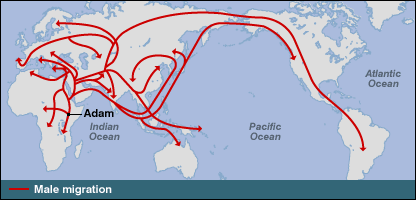
Map shows first migratory routes taken by humans, based on surveys of different types of the male Y chromosome. "Adam" represents the common ancestor from which all Y chromosomes descended
Neanderthals evolve about 250,000 years ago
Their range extends from Europe to Central Asia and the Middle East
Modern humans leave Africa about 60,000 years ago and arrive in Europe around 40,000 years ago
By 27,000 years ago, the Neanderthals are extinct
Possible reasons include climate change and competition with modern humans
Research based on DNA testing of 10,000 people from indigenous populations around the world
Source: The Genographic Project
By Alison Ross
BBC News
Improved technologies for extracting genetic material from fossils may help us find out more about our ancient ancestors.
Scientists in Israel have just developed a new technique to retrieve better quality, less contaminated DNA from very old remains, including human bones. It could aid the study of the evolution and migration of early modern humans, as well as extinct populations such as our close relatives, the Neanderthals.
Many researchers would dearly love to get their hands on DNA samples from hominids further back in time - from those that lived 100,000 years ago or more - to find out how they were related to people alive today.
But fossil studies this far back in time have long been hindered by contamination with foreign genetic material and the problem of recovering long, intact DNA sequences.
The new method provides hope, however.
What's real?
"DNA gets everywhere. So when we're dealing with a sample and you find it's got human DNA in it - is that DNA from the fossil, or is it actually DNA from the person who unearthed it?" says Professor Chris Stringer, the head of human origins at the Natural History Museum in London, UK.
Also, DNA falls apart over the course of time. "It breaks up into very small fragments so it is quite technically complicated to put it all back together again," explains Dr Robert Foley, the director of the Leverhulme Centre for Human Evolutionary Studies at the University of Cambridge, UK.
Freezing provides the ideal preservation conditions. The most widely accepted oldest DNA yet isolated comes from 400,000-year-old plants found in ice in Siberia. But most specimens are not excavated from such places.
An improved technique for retrieving DNA from fossil bone, just published in the journal Proceedings of the National Academy of Sciences (PNAS), may help.
Dr Michal Salamon, from the Weizmann Institute of Science in Rehovot, Israel, and colleagues, showed that "crystal aggregates", small mineral pockets formed during fossilisation, can preserve DNA better than the rest of the bone.
They compared DNA extracted from these crystal aggregates with genetic material taken from untreated, whole-bone powder. The samples were taken from eight different modern and fossil bones.
They found better preserved, less contaminated DNA could be recovered from the isolated crystals. This approach, "significantly improves the chances of obtaining authentic ancient DNA sequences, especially from human bones", they told PNAS.
Commenting on the latest research, Dr Michael Hofreiter, from the Max Planck Institute for Evolutionary Anthropology in Leipzig, Germany, who helped decode 40,000-year-old nuclear DNA from a cave bear earlier this year, said: "It's possible; but there need to be more studies on more samples, and they need to show that you don't get human contamination of animal bones.
"Then I would believe that it is a breakthrough for ancient DNA research."
The big split
Scientists are hopeful the new technique will help them get at the DNA in the chromosomes of a cell - the nuclear DNA.
Ancient DNA research has so far mainly focused on mitochondria, the tiny "power-stations" of the cell. These exist outside of the nucleus and have their own DNA. And, although this information is very useful, it is more limited in its scope than that which could be obtained from nuclear DNA.
It is partly a question of sensitivity. "There's about 1,000 times more mitochondrial DNA than nuclear DNA in our cells, so it's much easier to pick up," explains Professor Stringer.
The mitochondrial DNA is inherited only through the egg - through females. This means it is a useful marker for tracing a line back into the past, as it has never been mixed with DNA from males.
"One of the most important discoveries from studying ancient mitochondrial DNA is the estimate of when humans diverged in evolution from the Neanderthals - around half a million years ago," according to Dr Foley.
Professor Stringer adds: "We've now got about 10 Neanderthal specimens of around 40-50,000 years old that have yielded DNA that is clearly distinct from anyone alive today."
This means scientists can be sure that it is ancient, not just modern DNA from contamination. It has also given them a measure of how different Neanderthals were from modern people. Neanderthals are three times as different from us as we all are from each other," says Professor Stringer.
Species debate
But there remains the hotly debated question of whether Neanderthals were a completely separate species to us. Professor Stringer says that they are if that assessment is based on studying their bone anatomy.
However, the evidence from mitochondrial DNA is somewhat ambiguous. "The mitochondrial DNA on its own can't tell us if we're a distinct species," he explains. "It depends what mammal you take. There are some species where the difference in mitochondrial DNA between us and Neanderthals would say they were a different species. "Whereas in chimpanzees, our closest relative, you could contain the variation between us and Neanderthals in a single species alive today in Africa."
Scientists need to recover better DNA from our fossils, especially the nuclear DNA. "Each gene has a separate evolution so to understand Neanderthals properly we will need different bits of their DNA to see if they're all telling us the same story," he adds.
Population movements
The male sex chromosome (the "Y") is useful for tracking male inheritance, since males inherit their Y chromosome only from their father.
Using both mitochondrial and Y chromosome DNA from people alive today, complex pathways have been mapped for how modern humans got to where they are - but there are problems.
Dr Mim Bower, an ancient DNA researcher at the McDonald Institute for Archaeological Research in Cambridge, UK, gives an example.
"Using modern DNA we see a different pattern of settlement in the Pacific islands between men and women - the mitochondrial DNA patterns show a different migration pattern to the Y chromosome DNA."
Studying the DNA not of modern humans but of their distant ancestors could help answer such questions.
"At the moment we can't follow that into the past as it's very difficult to get nuclear DNA," Dr Bower says.
This is especially problematic for the Y chromosome, which is nuclear.
Monday, September 5, 2005
Kannaim: Moon Landing Was a Hoax
Reliable sources in Israel tell me that one of the kannaim, part of the group behind the Slifkin ban and intent on delegitimizing the Kamenetzky family (which is what the drive behind the Slifkin ban was actually all about), has been showing people a Foxtel documentary proving that astronauts never landed on the moon and it was all faked by NASA!
What the heck??
Well, this is in reference to the famous account of Reb Yaakov Kamenetzky z"l who watched the moon landing and concluded that Rambam was not correct in describing the moon as a spiritual being. The kannoim hope to show that Hollywood fooled Reb Yaakov into being a kofer. Evidently they will go to any lengths to try and prove this. What a bunch of maniacs. How can the Gedolim be so stupid as to listen to these people?
In fact the kannaim are not even following their own retarded ideology. I blogged about the fake moon landing months ago. The kannoim are forgetting the obvious peshat: The moon used to be a spiritual body, but then nishtaneh hatevah (actually nishtaneh hayareach) and now it's made of granite. So the Rambam wasn't actually wrong (in his time) at all. And why not? You think that's any more ridiculous than using nishtaneh hatevah to explain why lice have babies, whereas 2000 years ago they spontaneously generated?
Sometimes, I can understand why the skeptics just want the heck out of here. How much stupidity do we have to endure? Even otherwise sensible people have been spouting nonsense recently, in reference to my mythology post. Here is a sampling:
1. You have too much faith in science. You have more emunah in science
than in Torah.
(No, I have emunah in proven facts.)
2. Science changes all the time. All this will change too.
(Right. Ultimately scientists will realize that the world is exactly 5765 years old after all! Sure.)
3. The scientists disagree between themselves, so why should we listen to them.
(Right. One scientist says the world is 10 billion years old and another says 20 billion. So you see they can be wrong by billions of years! Maybe they are wrong by 10 to 20 billion years and the world is 5765 years old after all. Sure.)
4. Science can only document the present, it cannot 'predict' the past.
(Nonsense. Unless you invoke bizarre miracles.)
5. Science by definition can't accept G-d, so obviously they don't agree to Breishis.
(Nonsense.)
Other people kvetch and kvetch and kvetch. Well day doesn't mean day. And vegetation (created before the sun) doesn't really mean vegetation. It just means the potential for vegetation. And the sun didn't fully form until after earth was created, so maybe that's what the pasuk means when it talks about the creation of earth before the sun. And maybe Adam & Eve were just two special people. And maybe the flood was just a local flood. And when it says 'all the animals' it just means all the local animals. And maybe in the tower of bavel story everyone knew different languages already but they spoke a common one too, and then G-d made them forget the common one. And on and on and on.
I think it would be useful for the kvetchers to stop and rethink what they just turned Breishis into. A story about 2 people with slightly different neshamas? A story about a small flood and one guy who survived it? And a failed building project?!. What's the big deal?
I think the problem is that people don't understand what Mythology is. Mythology doesn't mean bube mayses. Mythology doesn't mean fairy tales for children. Mythology doesn't mean urban myths.
Mythology means great truths encoded in the form of an easy to remember story. Myths typcially formed before writing was invented, and hence had to survive oral transmission for hundreds or even thousands of years. Even Mythology created after writing was invented still had to be easy to remember and interesting and exciting to hear, guaranteeing that it would be passed down from generation to generation without being forgotten.
Breishis being Mythology does not mean it is all a waste of time. There are great and serious lessons in Breishis. But this does not mean Breishis is literally true, nor does it mean you should twist and bastardize basic peshat to try and get it to fit with current Science. The stories told in Breishis do not fit with the Scientific explanation of the world. Period. Making them fit by twisting the Science or by twisting the Torah is the wrong mehalech.
What the heck??
Well, this is in reference to the famous account of Reb Yaakov Kamenetzky z"l who watched the moon landing and concluded that Rambam was not correct in describing the moon as a spiritual being. The kannoim hope to show that Hollywood fooled Reb Yaakov into being a kofer. Evidently they will go to any lengths to try and prove this. What a bunch of maniacs. How can the Gedolim be so stupid as to listen to these people?
In fact the kannaim are not even following their own retarded ideology. I blogged about the fake moon landing months ago. The kannoim are forgetting the obvious peshat: The moon used to be a spiritual body, but then nishtaneh hatevah (actually nishtaneh hayareach) and now it's made of granite. So the Rambam wasn't actually wrong (in his time) at all. And why not? You think that's any more ridiculous than using nishtaneh hatevah to explain why lice have babies, whereas 2000 years ago they spontaneously generated?
Sometimes, I can understand why the skeptics just want the heck out of here. How much stupidity do we have to endure? Even otherwise sensible people have been spouting nonsense recently, in reference to my mythology post. Here is a sampling:
1. You have too much faith in science. You have more emunah in science
than in Torah.
(No, I have emunah in proven facts.)
2. Science changes all the time. All this will change too.
(Right. Ultimately scientists will realize that the world is exactly 5765 years old after all! Sure.)
3. The scientists disagree between themselves, so why should we listen to them.
(Right. One scientist says the world is 10 billion years old and another says 20 billion. So you see they can be wrong by billions of years! Maybe they are wrong by 10 to 20 billion years and the world is 5765 years old after all. Sure.)
4. Science can only document the present, it cannot 'predict' the past.
(Nonsense. Unless you invoke bizarre miracles.)
5. Science by definition can't accept G-d, so obviously they don't agree to Breishis.
(Nonsense.)
Other people kvetch and kvetch and kvetch. Well day doesn't mean day. And vegetation (created before the sun) doesn't really mean vegetation. It just means the potential for vegetation. And the sun didn't fully form until after earth was created, so maybe that's what the pasuk means when it talks about the creation of earth before the sun. And maybe Adam & Eve were just two special people. And maybe the flood was just a local flood. And when it says 'all the animals' it just means all the local animals. And maybe in the tower of bavel story everyone knew different languages already but they spoke a common one too, and then G-d made them forget the common one. And on and on and on.
I think it would be useful for the kvetchers to stop and rethink what they just turned Breishis into. A story about 2 people with slightly different neshamas? A story about a small flood and one guy who survived it? And a failed building project?!. What's the big deal?
I think the problem is that people don't understand what Mythology is. Mythology doesn't mean bube mayses. Mythology doesn't mean fairy tales for children. Mythology doesn't mean urban myths.
Mythology means great truths encoded in the form of an easy to remember story. Myths typcially formed before writing was invented, and hence had to survive oral transmission for hundreds or even thousands of years. Even Mythology created after writing was invented still had to be easy to remember and interesting and exciting to hear, guaranteeing that it would be passed down from generation to generation without being forgotten.
Breishis being Mythology does not mean it is all a waste of time. There are great and serious lessons in Breishis. But this does not mean Breishis is literally true, nor does it mean you should twist and bastardize basic peshat to try and get it to fit with current Science. The stories told in Breishis do not fit with the Scientific explanation of the world. Period. Making them fit by twisting the Science or by twisting the Torah is the wrong mehalech.
Thursday, September 1, 2005
Breishis & Science
Does Breishis fit with Science?
I'm glad you asked! Let’s see by looking at the text. I shall ignore Midrashic explanations which tend to be even more fantastical than the basic text and just focus on the basic text. Let’s go chapter by chapter through the beginning of Breishis and see what happens. I shall focus on the aspects of the Breishis story that are relevant to Science, and ignore other details that are not. Contradictions within the text itself shall be ignored, as shall obvious similarities to other ancient texts.
1. Breishis 1
Creation starts approximately 5765 years ago with Water. Next comes light, and then the first day ends. Second day, G-d creates Heaven and Earth, by separating the Waters. Third day, G-d moves around the lower waters, and thereby creates dry land and seas, and then creates vegetation on the earth. On the fourth day, G-d created the Sun, the moon and the stars. On the fifth day, G-d created all aquatic creatures, including Sea monsters, and also all birds. On the 6th day, G-d created animals, insects and then finally man and woman.
1. Science
Creation (of the current Universe) starts approximately 15 billion years ago with a Big Bang of energy, no Water. The energy could conceivably be called ‘light’. There is no separation of water into Heaven and Earth. For the next 10 billion years, various galaxies, stars and planets are born and die. Finally, about 4-8 billion years ago, our solar system is formed. The sun forms first and then the surrounding planets. Many stars obviously precede the earth’s formation, and vegetation obviously does not come before the Sun. Life starts in the seas about billion years ago, and then slowly spreads to the land first, and then to the sky. Dinosaurs rule the earth from about 300 million years ago to about 65 million years ago. Man (and of course woman) appear in some form about 2 million years ago. For the next 2 million years, Man (and woman) slowly evolve from primitive ape like beings to modern Homo Sapiens. Language appears about 100,000 years ago (if not earlier). Cave Paintings appear about 30,000 years ago. Man migrates out of Africa (or maybe India) and spreads across all 5 continents. 10,000 years ago we have intelligent man living in North America, Australia, Africa, Europe in many places. Pottery, art, language, even some basic farming are commonplace.
1. Conclusion
No match.
2. Breishis 2
G-d created a man, called Adam, and then placed him in the Garden of Eden, somewhere near present day Iraq/Iran. G-d tells Adam to eat from any tree. But not the tree of Good & Evil. Adam names all the animals but doesn’t have a mate. G-d recognizes that this isn’t good, so G-d makes him sleep, and then takes one of his ribs and creates a woman. They are both naked, and are not ashamed.
2. Science
The area described as Gan Eden is quite lush and fertile, and civilization does blossom there. As well as many other places in the world. Women and man both evolve from earlier forms.
2. Conclusion
No match.
3. Breishis 3
A talking snake convinces the woman to eat the forbidden fruit. G-d is unhappy and banishes the man and woman from the Garden. He punishes the snake by making it crawl, women are punished by being subservient and having childbirth pains, and men in general punished by having to work the ground for food. G-d creates clothes for Adam, and Adam calls his wife Eve.
3. Science
Snakes don’t talk, and fruit is fruit. Biologically, childbirth has been difficult for at least 100,000 years, since babies have large heads which are difficult to fit through the birth canal. Snakes have also been crawling for millions of years. Early man started to farm (as opposed ti hunt) about 10,000 years ago. Farming was always difficult. Clothes were invented at least 100,000 years ago.
3. Conclusion
No match.
4. Breishis 4
Adam and Eve have two sons, Cain & Abel. Cain kills Abel and G-d marks him so that he won’t be killed by other people (which other people?). Cain has children. And 7 generations later he has Yovol and Yuvol and Tuval-Cain, originators of nomadic life, musical instruments and brass & iron respectively.
4. Science
• 29,000–25,000 BCE - First ceramic appears
• 3rd millennium BC - Copper metallurgy is invented and copper is used for ornamentation
• 2nd millennium BC - Bronze is used for weapons and armour
• 1st millennium BC - Pewter beginning to be used in China and Egypt
• 16th century BC - The Hittites develop crude iron metallurgy
• 13th century BC - Invention of steel when iron and charcoal are combined properly
4. Conclusion
Partial match.
5. Breishis 5
Adam lived 930 years. Seht lives 912 years. Enosh lives 905 years. Kenan lives 910 years. Chanoch lives 365 years. Lamech lives 777 years. Noach is 500 years old, and has 3 children.
5. Science
Average lifespans tend to rise and fall depending on the region of the world and time perod, but generally fall into the range of 30-80 years. Maximum human lifespan would seem to be 120-150 years. All ancient bodies dug up (5000-10000 years old) are within the 30-80 range, usually at the low end. Living past 200 years might be possible in the future, but not in the past.
5. Conclusion
No match.
6. Breishis 6
Sons of gods (rulers?) steal daughters of men. G-d is unhappy, and limits human lifespan to 120 years. Nephilim (giants?) roam the earth. G-d is unhappy with the violence on the earth, and vows to destroy all mankind. However Noach finds favor, so G-d commands him to build a boat, and gives him detailed instructions. G-d tells Noach to take 2 of every kind of animal into the Ark, and food.
6. Science
There are no sons of gods (at least according to Judaism). There are also no giants. Boats are commonplace about 4,000 years ago.
6. Conclusion
Partial Match.
7. Breishis 7
Approximately 5,000 years ago, G-d says he will cause it to rain and blot out every living being on the earth. The fountains of the deep were opened, as well as the storehouses of the heavens. All the high mountains under all the heavens are covered in water. Every single animal, fish and insect dies, only Noah is saved.
7. Science
There were many local floods throughout the world. An ice age ended about 20,000 years ago in Europe causing massive flooding. There was also potentially a major flood in the Caspian see area about 8,000 years ago. In all cases, only the local populations and animals were affected. No mountains were ever covered in water. That much water does not exist on the planet, nor could the planet sustain so much water. There are no ‘fountains of the deep’, nor ‘storehouses in the heaven’ of such vast quantities of water. Geological and archeological evidence from a variety of sites all over the world show uninterrupted human habitation and development for at least the past 30,000 years, and show that a global flood never happened.
7. Conclusion
No match.
8. Breishis 8
The flood eventually ends and Noah and his wife and sons leave the Ark. They repopulate the earth with animals, fish and birds, since everything was wiped out. There are no other humans besides them.
8. Science
Archeological and zoological evidence from all over the world show an uninterrupted development of human and animal life all over the planet. Some species have been indigenous to their areas for tens of thousands of years.
8. Conclusion
No match.
9. Breishis 9
Noah and his family repopulate the earth. Noah dies at 950 years old.
9. Science
Population and genetic studies, not to mention archeological data, show that the population of the earth with humans was unbroken and happened 30-50,000 years ago. There was no repopulation of humanity only 4,000 years ago from a single family.
9. Conclusion
No match.
10. Breishis 10
Geneology of Noach’s sons, showing how they repopulated the Earth.
10. Science
Same as above.
10. Conclusion
No match.
11. Breishis 11
The whole earth speaks one language, approximately 4,000 years ago. They buld a tower to heaven which displeases G-d. G-d scatters the men and causes them to have different languages. Men spread across the face of the earth. A geneology is decribed linking shem to Abraham
11. Science
Linguistic evolution shows language developed in many parts of the earth over the last 50 to 100,000 years. Human populations too.
11. Conclusion
No match.
Conclusion
Clearly, 99% of the Science of the first 11 chapters does not match accepted Science. The only thing that came close was the invention of metal working. So, what are we to do?
Obviously you can claim that all Science is the work of evil atheist reshoim and therefore unreliable, or alternatively everything is a Ness. However Science is clearly reliable, and nothing is a Ness unless the Torah explicitly says it is (following the mehalech of the Rambam).
This leaves us with 2 options.
1. Kvetch like crazy to come up with far out Scientific theories, take many of the words non literally, ignore many difficult passages and create a story which is entirely far fetched, does not really match the accepted scientific account and destroys much of the meaning and impact in the text
2. Explain the whole thing as mythology which was included in the Torah for the important moral and spiritual lessons it teaches us.
I call option 1 the ‘Kiruv Clown’ option.
I'm glad you asked! Let’s see by looking at the text. I shall ignore Midrashic explanations which tend to be even more fantastical than the basic text and just focus on the basic text. Let’s go chapter by chapter through the beginning of Breishis and see what happens. I shall focus on the aspects of the Breishis story that are relevant to Science, and ignore other details that are not. Contradictions within the text itself shall be ignored, as shall obvious similarities to other ancient texts.
1. Breishis 1
Creation starts approximately 5765 years ago with Water. Next comes light, and then the first day ends. Second day, G-d creates Heaven and Earth, by separating the Waters. Third day, G-d moves around the lower waters, and thereby creates dry land and seas, and then creates vegetation on the earth. On the fourth day, G-d created the Sun, the moon and the stars. On the fifth day, G-d created all aquatic creatures, including Sea monsters, and also all birds. On the 6th day, G-d created animals, insects and then finally man and woman.
1. Science
Creation (of the current Universe) starts approximately 15 billion years ago with a Big Bang of energy, no Water. The energy could conceivably be called ‘light’. There is no separation of water into Heaven and Earth. For the next 10 billion years, various galaxies, stars and planets are born and die. Finally, about 4-8 billion years ago, our solar system is formed. The sun forms first and then the surrounding planets. Many stars obviously precede the earth’s formation, and vegetation obviously does not come before the Sun. Life starts in the seas about billion years ago, and then slowly spreads to the land first, and then to the sky. Dinosaurs rule the earth from about 300 million years ago to about 65 million years ago. Man (and of course woman) appear in some form about 2 million years ago. For the next 2 million years, Man (and woman) slowly evolve from primitive ape like beings to modern Homo Sapiens. Language appears about 100,000 years ago (if not earlier). Cave Paintings appear about 30,000 years ago. Man migrates out of Africa (or maybe India) and spreads across all 5 continents. 10,000 years ago we have intelligent man living in North America, Australia, Africa, Europe in many places. Pottery, art, language, even some basic farming are commonplace.
1. Conclusion
No match.
2. Breishis 2
G-d created a man, called Adam, and then placed him in the Garden of Eden, somewhere near present day Iraq/Iran. G-d tells Adam to eat from any tree. But not the tree of Good & Evil. Adam names all the animals but doesn’t have a mate. G-d recognizes that this isn’t good, so G-d makes him sleep, and then takes one of his ribs and creates a woman. They are both naked, and are not ashamed.
2. Science
The area described as Gan Eden is quite lush and fertile, and civilization does blossom there. As well as many other places in the world. Women and man both evolve from earlier forms.
2. Conclusion
No match.
3. Breishis 3
A talking snake convinces the woman to eat the forbidden fruit. G-d is unhappy and banishes the man and woman from the Garden. He punishes the snake by making it crawl, women are punished by being subservient and having childbirth pains, and men in general punished by having to work the ground for food. G-d creates clothes for Adam, and Adam calls his wife Eve.
3. Science
Snakes don’t talk, and fruit is fruit. Biologically, childbirth has been difficult for at least 100,000 years, since babies have large heads which are difficult to fit through the birth canal. Snakes have also been crawling for millions of years. Early man started to farm (as opposed ti hunt) about 10,000 years ago. Farming was always difficult. Clothes were invented at least 100,000 years ago.
3. Conclusion
No match.
4. Breishis 4
Adam and Eve have two sons, Cain & Abel. Cain kills Abel and G-d marks him so that he won’t be killed by other people (which other people?). Cain has children. And 7 generations later he has Yovol and Yuvol and Tuval-Cain, originators of nomadic life, musical instruments and brass & iron respectively.
4. Science
• 29,000–25,000 BCE - First ceramic appears
• 3rd millennium BC - Copper metallurgy is invented and copper is used for ornamentation
• 2nd millennium BC - Bronze is used for weapons and armour
• 1st millennium BC - Pewter beginning to be used in China and Egypt
• 16th century BC - The Hittites develop crude iron metallurgy
• 13th century BC - Invention of steel when iron and charcoal are combined properly
4. Conclusion
Partial match.
5. Breishis 5
Adam lived 930 years. Seht lives 912 years. Enosh lives 905 years. Kenan lives 910 years. Chanoch lives 365 years. Lamech lives 777 years. Noach is 500 years old, and has 3 children.
5. Science
Average lifespans tend to rise and fall depending on the region of the world and time perod, but generally fall into the range of 30-80 years. Maximum human lifespan would seem to be 120-150 years. All ancient bodies dug up (5000-10000 years old) are within the 30-80 range, usually at the low end. Living past 200 years might be possible in the future, but not in the past.
5. Conclusion
No match.
6. Breishis 6
Sons of gods (rulers?) steal daughters of men. G-d is unhappy, and limits human lifespan to 120 years. Nephilim (giants?) roam the earth. G-d is unhappy with the violence on the earth, and vows to destroy all mankind. However Noach finds favor, so G-d commands him to build a boat, and gives him detailed instructions. G-d tells Noach to take 2 of every kind of animal into the Ark, and food.
6. Science
There are no sons of gods (at least according to Judaism). There are also no giants. Boats are commonplace about 4,000 years ago.
6. Conclusion
Partial Match.
7. Breishis 7
Approximately 5,000 years ago, G-d says he will cause it to rain and blot out every living being on the earth. The fountains of the deep were opened, as well as the storehouses of the heavens. All the high mountains under all the heavens are covered in water. Every single animal, fish and insect dies, only Noah is saved.
7. Science
There were many local floods throughout the world. An ice age ended about 20,000 years ago in Europe causing massive flooding. There was also potentially a major flood in the Caspian see area about 8,000 years ago. In all cases, only the local populations and animals were affected. No mountains were ever covered in water. That much water does not exist on the planet, nor could the planet sustain so much water. There are no ‘fountains of the deep’, nor ‘storehouses in the heaven’ of such vast quantities of water. Geological and archeological evidence from a variety of sites all over the world show uninterrupted human habitation and development for at least the past 30,000 years, and show that a global flood never happened.
7. Conclusion
No match.
8. Breishis 8
The flood eventually ends and Noah and his wife and sons leave the Ark. They repopulate the earth with animals, fish and birds, since everything was wiped out. There are no other humans besides them.
8. Science
Archeological and zoological evidence from all over the world show an uninterrupted development of human and animal life all over the planet. Some species have been indigenous to their areas for tens of thousands of years.
8. Conclusion
No match.
9. Breishis 9
Noah and his family repopulate the earth. Noah dies at 950 years old.
9. Science
Population and genetic studies, not to mention archeological data, show that the population of the earth with humans was unbroken and happened 30-50,000 years ago. There was no repopulation of humanity only 4,000 years ago from a single family.
9. Conclusion
No match.
10. Breishis 10
Geneology of Noach’s sons, showing how they repopulated the Earth.
10. Science
Same as above.
10. Conclusion
No match.
11. Breishis 11
The whole earth speaks one language, approximately 4,000 years ago. They buld a tower to heaven which displeases G-d. G-d scatters the men and causes them to have different languages. Men spread across the face of the earth. A geneology is decribed linking shem to Abraham
11. Science
Linguistic evolution shows language developed in many parts of the earth over the last 50 to 100,000 years. Human populations too.
11. Conclusion
No match.
Conclusion
Clearly, 99% of the Science of the first 11 chapters does not match accepted Science. The only thing that came close was the invention of metal working. So, what are we to do?
Obviously you can claim that all Science is the work of evil atheist reshoim and therefore unreliable, or alternatively everything is a Ness. However Science is clearly reliable, and nothing is a Ness unless the Torah explicitly says it is (following the mehalech of the Rambam).
This leaves us with 2 options.
1. Kvetch like crazy to come up with far out Scientific theories, take many of the words non literally, ignore many difficult passages and create a story which is entirely far fetched, does not really match the accepted scientific account and destroys much of the meaning and impact in the text
2. Explain the whole thing as mythology which was included in the Torah for the important moral and spiritual lessons it teaches us.
I call option 1 the ‘Kiruv Clown’ option.
Subscribe to:
Posts (Atom)