The idiots on Avodah can't seem to give up their Bittul Torah discussion on Evolution and the age of the Universe. This weeks prime offender is Simcha Coffer, the guy just doesn't give up, which is a shame, since the position he is not giving up is a moronic one. Here is a great quote from Coffer, clearly showing his lunatic opinions:
If you're going to contradict the scientists, you may as well go the whole way (i.e. the correct way IMO) and say that in truth they really have no evidence at all. Once you come to this realization, the necessity of reconciling vast periods of time with [Maase Breishit] becomes obsolete.
But some blame must go to Micha Berger too, for actually engaging this guy in serious discussion. Micha, is there really any point? Don't you have anything better to do? Don't you realize that Coffer (and Ostroff) are crazy fundamentalists? They are not interested in reason. They have their pre-formed ideological opinions and all the evidence in the world is not going to change their minds. Arguing with these fools is like arguing with mental patients.
In case you missed it, here is some advice for you Avodah guys. (This advice also applies to Rabbi Slifkin and the Kiruv Clowns too). A basic assumption of your mehalech should be that you accept established science. That's it. No discussion, not argument, no proofs required. You accept it and then you move on from there. If you need to explain why you accept it, then you are probably talking to the wrong audience.
Showing posts with label Science. Show all posts
Showing posts with label Science. Show all posts
Sunday, September 25, 2005
Monday, September 19, 2005
'Better' DNA out of fossil bones
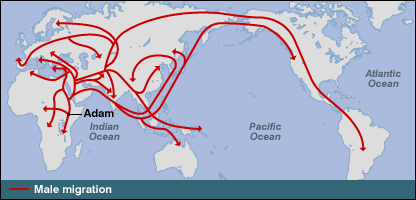
Map shows first migratory routes taken by humans, based on surveys of different types of the male Y chromosome. "Adam" represents the common ancestor from which all Y chromosomes descended
Neanderthals evolve about 250,000 years ago
Their range extends from Europe to Central Asia and the Middle East
Modern humans leave Africa about 60,000 years ago and arrive in Europe around 40,000 years ago
By 27,000 years ago, the Neanderthals are extinct
Possible reasons include climate change and competition with modern humans
Research based on DNA testing of 10,000 people from indigenous populations around the world
Source: The Genographic Project
By Alison Ross
BBC News
Improved technologies for extracting genetic material from fossils may help us find out more about our ancient ancestors.
Scientists in Israel have just developed a new technique to retrieve better quality, less contaminated DNA from very old remains, including human bones. It could aid the study of the evolution and migration of early modern humans, as well as extinct populations such as our close relatives, the Neanderthals.
Many researchers would dearly love to get their hands on DNA samples from hominids further back in time - from those that lived 100,000 years ago or more - to find out how they were related to people alive today.
But fossil studies this far back in time have long been hindered by contamination with foreign genetic material and the problem of recovering long, intact DNA sequences.
The new method provides hope, however.
What's real?
"DNA gets everywhere. So when we're dealing with a sample and you find it's got human DNA in it - is that DNA from the fossil, or is it actually DNA from the person who unearthed it?" says Professor Chris Stringer, the head of human origins at the Natural History Museum in London, UK.
Also, DNA falls apart over the course of time. "It breaks up into very small fragments so it is quite technically complicated to put it all back together again," explains Dr Robert Foley, the director of the Leverhulme Centre for Human Evolutionary Studies at the University of Cambridge, UK.
Freezing provides the ideal preservation conditions. The most widely accepted oldest DNA yet isolated comes from 400,000-year-old plants found in ice in Siberia. But most specimens are not excavated from such places.
An improved technique for retrieving DNA from fossil bone, just published in the journal Proceedings of the National Academy of Sciences (PNAS), may help.
Dr Michal Salamon, from the Weizmann Institute of Science in Rehovot, Israel, and colleagues, showed that "crystal aggregates", small mineral pockets formed during fossilisation, can preserve DNA better than the rest of the bone.
They compared DNA extracted from these crystal aggregates with genetic material taken from untreated, whole-bone powder. The samples were taken from eight different modern and fossil bones.
They found better preserved, less contaminated DNA could be recovered from the isolated crystals. This approach, "significantly improves the chances of obtaining authentic ancient DNA sequences, especially from human bones", they told PNAS.
Commenting on the latest research, Dr Michael Hofreiter, from the Max Planck Institute for Evolutionary Anthropology in Leipzig, Germany, who helped decode 40,000-year-old nuclear DNA from a cave bear earlier this year, said: "It's possible; but there need to be more studies on more samples, and they need to show that you don't get human contamination of animal bones.
"Then I would believe that it is a breakthrough for ancient DNA research."
The big split
Scientists are hopeful the new technique will help them get at the DNA in the chromosomes of a cell - the nuclear DNA.
Ancient DNA research has so far mainly focused on mitochondria, the tiny "power-stations" of the cell. These exist outside of the nucleus and have their own DNA. And, although this information is very useful, it is more limited in its scope than that which could be obtained from nuclear DNA.
It is partly a question of sensitivity. "There's about 1,000 times more mitochondrial DNA than nuclear DNA in our cells, so it's much easier to pick up," explains Professor Stringer.
The mitochondrial DNA is inherited only through the egg - through females. This means it is a useful marker for tracing a line back into the past, as it has never been mixed with DNA from males.
"One of the most important discoveries from studying ancient mitochondrial DNA is the estimate of when humans diverged in evolution from the Neanderthals - around half a million years ago," according to Dr Foley.
Professor Stringer adds: "We've now got about 10 Neanderthal specimens of around 40-50,000 years old that have yielded DNA that is clearly distinct from anyone alive today."
This means scientists can be sure that it is ancient, not just modern DNA from contamination. It has also given them a measure of how different Neanderthals were from modern people. Neanderthals are three times as different from us as we all are from each other," says Professor Stringer.
Species debate
But there remains the hotly debated question of whether Neanderthals were a completely separate species to us. Professor Stringer says that they are if that assessment is based on studying their bone anatomy.
However, the evidence from mitochondrial DNA is somewhat ambiguous. "The mitochondrial DNA on its own can't tell us if we're a distinct species," he explains. "It depends what mammal you take. There are some species where the difference in mitochondrial DNA between us and Neanderthals would say they were a different species. "Whereas in chimpanzees, our closest relative, you could contain the variation between us and Neanderthals in a single species alive today in Africa."
Scientists need to recover better DNA from our fossils, especially the nuclear DNA. "Each gene has a separate evolution so to understand Neanderthals properly we will need different bits of their DNA to see if they're all telling us the same story," he adds.
Population movements
The male sex chromosome (the "Y") is useful for tracking male inheritance, since males inherit their Y chromosome only from their father.
Using both mitochondrial and Y chromosome DNA from people alive today, complex pathways have been mapped for how modern humans got to where they are - but there are problems.
Dr Mim Bower, an ancient DNA researcher at the McDonald Institute for Archaeological Research in Cambridge, UK, gives an example.
"Using modern DNA we see a different pattern of settlement in the Pacific islands between men and women - the mitochondrial DNA patterns show a different migration pattern to the Y chromosome DNA."
Studying the DNA not of modern humans but of their distant ancestors could help answer such questions.
"At the moment we can't follow that into the past as it's very difficult to get nuclear DNA," Dr Bower says.
This is especially problematic for the Y chromosome, which is nuclear.

Wednesday, April 20, 2005
Radical Skepticism vs Common Sense
Some people just don't get it. I have explained this so many times, and they still don't get it. Please, please, please try to understand, before one of us dies. (Bonus points: Who said that ?)
Nothing can ever be absolutely proven 100%. You can always be a radical skeptic. There might be a global conspiracy to lie to you. We might all be brains in a jar. The whole world might be an illusion. However, we have to live our lives according to what is extremely probable, not what might, in some bizarre way, be remotely possible. It might be possible that Science is all wrong, but that doesn't stop us from getting on a plane or taking medicine.
It might be possible that my spouse is really my sister. Does that mean I can't go home ? It might be possible, so surely I wouldn't want to be oyver on Giluy Arayos ! Clearly, this is ridicluous. Even when it comes to yehoreg ve'al yaavor, we hold by common sense and chazakah. Since there is no reason to assume otherwise, its not Giluy Arayos.
Similarly, if the global majority of experts hold of something, and there is no reason to assume any pre-conceived bias or incorrect assumptions, then its only secheldick to agree. Its not a case of having "too much faith in Science". Its not a case of having "Emunah Peshuta in Science". Its not "trusting the Scientists more than the Gedolim". Its basic, common sense. Its the only reasonable way to live life. If you jettison common sense, then nothing makes sense.
Thats what it boils down to. This basic and fundamental premise precedes everything else, it has to. If you can question reality, you get nowhere. Once you have this assumption, then you realize that parts of the Torah must be re-interpreted. Those people who come up with bizarre nonsensical Nes-Nisayon theories, or who say we can't believe the Scientists, are making a very fundamental mistake.
Of course some parts of Science are less proven. Some parts are based on assumptions that we discount. For example, some aspects of evolutionary theory are based on the assumption that there was no preconceived plan for life. If you hold G-d did plan life, you might argue on this.
However, those parts which are proven, which are not based on any faulty assumptions, but simply on honest experimentation and evaluation of the evidence, need to be accepted. Of course its always possible that in some bizarre event of extremely low probability, something might be disproven. Nu, if it happens, then it happens. But you can't live your life or construct your ideology based on what might possibly happen.
If you do, you might need to be committed to an asylum.
Nothing can ever be absolutely proven 100%. You can always be a radical skeptic. There might be a global conspiracy to lie to you. We might all be brains in a jar. The whole world might be an illusion. However, we have to live our lives according to what is extremely probable, not what might, in some bizarre way, be remotely possible. It might be possible that Science is all wrong, but that doesn't stop us from getting on a plane or taking medicine.
It might be possible that my spouse is really my sister. Does that mean I can't go home ? It might be possible, so surely I wouldn't want to be oyver on Giluy Arayos ! Clearly, this is ridicluous. Even when it comes to yehoreg ve'al yaavor, we hold by common sense and chazakah. Since there is no reason to assume otherwise, its not Giluy Arayos.
Similarly, if the global majority of experts hold of something, and there is no reason to assume any pre-conceived bias or incorrect assumptions, then its only secheldick to agree. Its not a case of having "too much faith in Science". Its not a case of having "Emunah Peshuta in Science". Its not "trusting the Scientists more than the Gedolim". Its basic, common sense. Its the only reasonable way to live life. If you jettison common sense, then nothing makes sense.
Thats what it boils down to. This basic and fundamental premise precedes everything else, it has to. If you can question reality, you get nowhere. Once you have this assumption, then you realize that parts of the Torah must be re-interpreted. Those people who come up with bizarre nonsensical Nes-Nisayon theories, or who say we can't believe the Scientists, are making a very fundamental mistake.
Of course some parts of Science are less proven. Some parts are based on assumptions that we discount. For example, some aspects of evolutionary theory are based on the assumption that there was no preconceived plan for life. If you hold G-d did plan life, you might argue on this.
However, those parts which are proven, which are not based on any faulty assumptions, but simply on honest experimentation and evaluation of the evidence, need to be accepted. Of course its always possible that in some bizarre event of extremely low probability, something might be disproven. Nu, if it happens, then it happens. But you can't live your life or construct your ideology based on what might possibly happen.
If you do, you might need to be committed to an asylum.
Monday, April 18, 2005
Do I Worship the God of Science ?
Some people have criticized me saying that I worship the 'God of Science'. Well Science is certainly amazing, so lets think about this question for a few minutes.
Nothing in the field of human endeavor has had the same impact as Science, and it seems likely that nothing ever will. If you really stop to think about it, the level of success in the Scientific endeavor has been absolutely amazing. No other human endeavor has been so phenomenally successful in achieving its goals. We take so much of it for granted that we don't even realize just how incredible it all is.
Some people like to quote the saying "hafoch boh dkuloh boh" (everything is in the Torah) to show how Science is in the Torah. However, this phenomenal Scientific success did not come from the Gedolim learning Torah. It came from Scientists following their (non Torahdick) process.
Clearly, when "Hafoch boh" was said, Science in its current form did not exist. Nor did anything like it. Should we really take this phrase literally ? Of course not. In ancient times, Tenach was quite a good repository of 'wisdom', as the ancients defined it. Of course, some truths are eternal, and so the Torah's views on life, religion, morality etc are as good today as they ever were. However, when it comes to Science, there's nothing in there. Nothing. Hafoch Boh cannot possibly apply.
We should be incredibly grateful to the Scientists, and we should show the appropriate hakoras hatov. With all due respect, the Gedolim didn't find out the cures for cancer, the Scientists did. Slandering Scientists when they find something which appears to contradict some fundamentalists viewpoint is the height of ingratitude and bad middos. Would we prefer to live without modern technology ? Without modern medicine ? Without modern travel ? (Actually yes to the last one but that's different !)
The incredible chochmah of Science is not really due to the Scientists though. They are simply reporting what they see, and trying to figure it out, slowly and painfully, one step at a time. But we realize that the true chochmah comes from somewhere else. This was stated 2500 years ago, in another well known phrase, which I do take literally. That phrase is "Moh Rabu Maasechoh Hashem, Kulom Bechochmoh Asisa."
Rav Herzog had this to say about Science:
It is unfortunate that while science is progressively conquering worlds and discovering all sorts of secrets, although it too errs at times, we like ostriches bury our heads in sand. It is imperative that we encourage the ablest students of the yeshivot also to be educated as men of science in each discipline, so that we should not need to turn to others in matters of physiology, chemistry, electricity, etc. concerning things that relate to our sacred Torah. ...
So do I worship the God of Science ?
Absolutely. Three times a day, four times on the weekend.
Don't you ?
Nothing in the field of human endeavor has had the same impact as Science, and it seems likely that nothing ever will. If you really stop to think about it, the level of success in the Scientific endeavor has been absolutely amazing. No other human endeavor has been so phenomenally successful in achieving its goals. We take so much of it for granted that we don't even realize just how incredible it all is.
Some people like to quote the saying "hafoch boh dkuloh boh" (everything is in the Torah) to show how Science is in the Torah. However, this phenomenal Scientific success did not come from the Gedolim learning Torah. It came from Scientists following their (non Torahdick) process.
Clearly, when "Hafoch boh" was said, Science in its current form did not exist. Nor did anything like it. Should we really take this phrase literally ? Of course not. In ancient times, Tenach was quite a good repository of 'wisdom', as the ancients defined it. Of course, some truths are eternal, and so the Torah's views on life, religion, morality etc are as good today as they ever were. However, when it comes to Science, there's nothing in there. Nothing. Hafoch Boh cannot possibly apply.
We should be incredibly grateful to the Scientists, and we should show the appropriate hakoras hatov. With all due respect, the Gedolim didn't find out the cures for cancer, the Scientists did. Slandering Scientists when they find something which appears to contradict some fundamentalists viewpoint is the height of ingratitude and bad middos. Would we prefer to live without modern technology ? Without modern medicine ? Without modern travel ? (Actually yes to the last one but that's different !)
The incredible chochmah of Science is not really due to the Scientists though. They are simply reporting what they see, and trying to figure it out, slowly and painfully, one step at a time. But we realize that the true chochmah comes from somewhere else. This was stated 2500 years ago, in another well known phrase, which I do take literally. That phrase is "Moh Rabu Maasechoh Hashem, Kulom Bechochmoh Asisa."
Rav Herzog had this to say about Science:
It is unfortunate that while science is progressively conquering worlds and discovering all sorts of secrets, although it too errs at times, we like ostriches bury our heads in sand. It is imperative that we encourage the ablest students of the yeshivot also to be educated as men of science in each discipline, so that we should not need to turn to others in matters of physiology, chemistry, electricity, etc. concerning things that relate to our sacred Torah. ...
So do I worship the God of Science ?
Absolutely. Three times a day, four times on the weekend.
Don't you ?
Wednesday, April 13, 2005
Emunas Scientistim
We spoke about Emunas Chachomim (good but not in the extremists), Emunas Kanoim (always bad), and Emunah Peshuta (sometimes ok). Now its time to talk about Emunas Scientistim.
In a previous post, I divided the world of science into 3 broad categories:
1. Proven Science.
These are theories that the majority of the Scientific Community accept are ‘proven’, (to the extent that anything can be ‘proven’).
2. Debatable Science
These theories (or some significant aspects thereof) are the subject of much debate within the scientific community, as to wether they are proven, (or even correct).
3. Theoretical Science
These theories are held by the majority of the scientific community to be theoretical, unproven and conjecture at this point.
I stated that I will argue Science vs Torah from catgeory 1. I will occasionally debate category 2 but not usually. I don’t go near Catgeory 3 to the best of my knowledge.
This stimulated much debate. I discerned three major questions.
Q1. You just have Emunah Peshuta in Science !
A1.1 Yes for Good Reason.
Its true, I have EP in the scientific community and process. This is for a number of reasons. The scientists come from a wide range of backgrounds, cultures and religions. The scientists employ an open process. The scientists encourage new experimentation and discussion of opposing views. There are many textbooks and popular books on science, explaining in great detail all the theories. Few scientists insist that you must have emunah peshutah in their theories, but then refuses to explain their reasoning ! Do I have a science phd ? No. Have I read all of science ? Of course not. However I have read enough of it to see its convincing. Therefore I have emunah peshutah, as long as the majority of the scientific community are in agreement.
A1.2. No, its not Emunah Peshuta
EP implies a faith in something for no good reason, other than that one needs to have faith. However my faith in Science is for all the good reasons stated above. Am I ultimately trusting the scientists ? Yes, in exactly the same way that I am ultimately trusting that everyone I have ever had any contact with since the day I was born has not been lying to me as part of some great, global conspiracy. That’s not emunah peshutah. That’s common sense.
Q2. If you believe the scientists, then you should believe the Documentary Hypothesis too !
A2.1 The Premise of DH is Wrong
The DH assumes that the Bible was man written, and the question is how many men wrote it. G-d writing the Bible is not entertained as a credible alternative. Even though general science also has this assumption, its not directly relevant there, since even G-d believers understand that there is a scientific mechanism to how the world was created and subsequently operates.
A2.2 DH is not ‘Proven’
Alternatively, DH may be in category 2, or even 3, not category 1. I am finding it difficult to figure out. Some people claim that not a single serious (non fundamentalist) Bible scholar in the world disagrees with the multiple authorship theory. Others say the theory is outdated 19th century scholarship which has been debunked.
A2.3 DH is not Science
I could also say that DH ‘Science’ is not in the same category at all as the other sciences (physics, biology etc). Its more of a soft science, which relies on conjecture and theories, rather than provable or observable expirements. My emunah in science is only in the hard sciences.
Q3. What if Science disproved an ikkar like Sinai, then what would you do ?
A3.1 It could never happen
I have emunah that science could never disprove a real ikkar (e.g. Sinai) since Science is true and Sinai is true, so one could not ever disprove another. Therefore the question is theoretical, could never happen and is not worth thinking about. You might as well ask, what if all the Gedolim said Sinai didn’t happen !
A3.2 The Truth is the Truth
I could also answer that if a category 1 science theory did actually disprove Sinai (and I mean mamash disprove, no doubt at all whatsoever), then it would show Sinai never happened, and that would be a fact. Truth is truth, and is surely the highest value. It would be a great shame, but there’s no point in denying reality.
A3.3 I would have emunah
Alternatively, I could say that if it came to something really fundamental, like Sinai, then I would not listen to the scientists. However, I don’t like this approach as much, because then the whole debate with the extremists just becomes quantative. i.e. We all have our limits as to when we will ignore reality, they just reach theirs sooner. However I think its qualatitive, they are nuts and I am not.
In a previous post, I divided the world of science into 3 broad categories:
1. Proven Science.
These are theories that the majority of the Scientific Community accept are ‘proven’, (to the extent that anything can be ‘proven’).
2. Debatable Science
These theories (or some significant aspects thereof) are the subject of much debate within the scientific community, as to wether they are proven, (or even correct).
3. Theoretical Science
These theories are held by the majority of the scientific community to be theoretical, unproven and conjecture at this point.
I stated that I will argue Science vs Torah from catgeory 1. I will occasionally debate category 2 but not usually. I don’t go near Catgeory 3 to the best of my knowledge.
This stimulated much debate. I discerned three major questions.
Q1. You just have Emunah Peshuta in Science !
A1.1 Yes for Good Reason.
Its true, I have EP in the scientific community and process. This is for a number of reasons. The scientists come from a wide range of backgrounds, cultures and religions. The scientists employ an open process. The scientists encourage new experimentation and discussion of opposing views. There are many textbooks and popular books on science, explaining in great detail all the theories. Few scientists insist that you must have emunah peshutah in their theories, but then refuses to explain their reasoning ! Do I have a science phd ? No. Have I read all of science ? Of course not. However I have read enough of it to see its convincing. Therefore I have emunah peshutah, as long as the majority of the scientific community are in agreement.
A1.2. No, its not Emunah Peshuta
EP implies a faith in something for no good reason, other than that one needs to have faith. However my faith in Science is for all the good reasons stated above. Am I ultimately trusting the scientists ? Yes, in exactly the same way that I am ultimately trusting that everyone I have ever had any contact with since the day I was born has not been lying to me as part of some great, global conspiracy. That’s not emunah peshutah. That’s common sense.
Q2. If you believe the scientists, then you should believe the Documentary Hypothesis too !
A2.1 The Premise of DH is Wrong
The DH assumes that the Bible was man written, and the question is how many men wrote it. G-d writing the Bible is not entertained as a credible alternative. Even though general science also has this assumption, its not directly relevant there, since even G-d believers understand that there is a scientific mechanism to how the world was created and subsequently operates.
A2.2 DH is not ‘Proven’
Alternatively, DH may be in category 2, or even 3, not category 1. I am finding it difficult to figure out. Some people claim that not a single serious (non fundamentalist) Bible scholar in the world disagrees with the multiple authorship theory. Others say the theory is outdated 19th century scholarship which has been debunked.
A2.3 DH is not Science
I could also say that DH ‘Science’ is not in the same category at all as the other sciences (physics, biology etc). Its more of a soft science, which relies on conjecture and theories, rather than provable or observable expirements. My emunah in science is only in the hard sciences.
Q3. What if Science disproved an ikkar like Sinai, then what would you do ?
A3.1 It could never happen
I have emunah that science could never disprove a real ikkar (e.g. Sinai) since Science is true and Sinai is true, so one could not ever disprove another. Therefore the question is theoretical, could never happen and is not worth thinking about. You might as well ask, what if all the Gedolim said Sinai didn’t happen !
A3.2 The Truth is the Truth
I could also answer that if a category 1 science theory did actually disprove Sinai (and I mean mamash disprove, no doubt at all whatsoever), then it would show Sinai never happened, and that would be a fact. Truth is truth, and is surely the highest value. It would be a great shame, but there’s no point in denying reality.
A3.3 I would have emunah
Alternatively, I could say that if it came to something really fundamental, like Sinai, then I would not listen to the scientists. However, I don’t like this approach as much, because then the whole debate with the extremists just becomes quantative. i.e. We all have our limits as to when we will ignore reality, they just reach theirs sooner. However I think its qualatitive, they are nuts and I am not.
Thursday, March 31, 2005
My views on science
Some people have accused me of having emunah peshutah in science. 'Not all science is proven' they say. 'Scientific theories change all the time', they say. 'You have more faith in Science than in Torah' they say. 'You are a fool for believing Science' they say.
I say, you haven't been paying attention.
Lets roughly categorize all of science into 3 groups of theories.
1. Proven
The first group we shall call "proven". This is simply a convenient name, so don't go getting all philosophical on me about how nothing can ever really be proven blah blah blah. I don't want to hear it. This group of theories are those that are accepted as true by the majority of the scientific community. The fact that some quack scientists or Kiruv Clowns might dispute these theories is irrelevant. Some simple examples (or rather ramifications) of 'proven' theories:
I say, you haven't been paying attention.
Lets roughly categorize all of science into 3 groups of theories.
1. Proven
The first group we shall call "proven". This is simply a convenient name, so don't go getting all philosophical on me about how nothing can ever really be proven blah blah blah. I don't want to hear it. This group of theories are those that are accepted as true by the majority of the scientific community. The fact that some quack scientists or Kiruv Clowns might dispute these theories is irrelevant. Some simple examples (or rather ramifications) of 'proven' theories:
- The world and the universe are many billions of years old
- There were many thousands of intelligent human beings roaming the earth, in the US, Australia, Asia etc, 10,000 years ago
- There was no global flood within the last million years.
Of course we can debate which theories belong in this group. However my measure is what the significant majority of scientifics think, not what you, I or the Gedolim think. If you think scientific opinion is all hooey, this blog is not for you.
2. Debatable
The second group we shall call "debatable". This group of theories is the subject of some debate within the scientific community itself, or alternatively, the scientific community itself accepts that these are not yet proven. Some examples of 'debatable' theories:
- Some aspects of evolutionary theory (which aspects are debatable is itself debatable)
- Possible lifespans of ancient humans
3. Theoretical
The third group we shall call "theoretical". These theories have been proposed, but there is no way of knowing (yet) if there is any validity to them or not. The mainstream scientific community accepts this. Some example of "theoretical" theories:
- Multiverse theory
- Some aspects of string theory (which aspects are theoretical is debatable)
My arguments regarding Torah have all been from the 'proven' group. This groups is to all intensive purposes established fact. Its not a question of faith, but of fact. If you disagree and have a well reasoned argument, I would be interested in hearing it. If you are simply a fundamentalist who rejects science out of hand, this blog is not for you, please leave.
I have never to my knowledge argued strongly against Torah in defence of a 'Theoretical' theory. If I have, I was mistaken. Sometimes I might debate the "debatable" theories, but not very often. This blog is about religion, not science, and I don't have much interest in debating scientific theories per se.
Scientific theories change all the time. However the fundamentals usually don't. They get refined, bits get added, bits get taken away but I think we can be secure in saying the world is round, gravity will always be, the world is very old, and things like that. To say that all science is hooey because it changes is the same as saying all halachah is hooey because it changes.
Another common fallacy is to take a genuine scientific debate and use it to void all opinions. A classic example is the debate over the age of the universe. Some scientists say 10 billion, some say 20 billion. Aha ! Say the fundamentalists. You see the scientists can't agree. One side could even be wrong by 10 billion years ! So maybe they are both wrong, and the world is only 6000 years old ! If you think this is a logical argument then again, this blog is not for you, please leave.
I hope I have made my views clear. Please do not clutter up the comments with silly statements about science. Thanks.
Subscribe to:
Posts (Atom)