Monday, September 19, 2005

'Better' DNA out of fossil bones


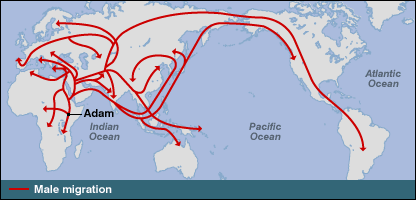
Map shows first migratory routes taken by humans, based on surveys of different types of the male Y chromosome. "Adam" represents the common ancestor from which all Y chromosomes descended

Neanderthals evolve about 250,000 years ago
Their range extends from Europe to Central Asia and the Middle East
Modern humans leave Africa about 60,000 years ago and arrive in Europe around 40,000 years ago
By 27,000 years ago, the Neanderthals are extinct
Possible reasons include climate change and competition with modern humans

Research based on DNA testing of 10,000 people from indigenous populations around the world

Source: The Genographic Project

By Alison Ross
BBC News

Improved technologies for extracting genetic material from fossils may help us find out more about our ancient ancestors.

Scientists in Israel have just developed a new technique to retrieve better quality, less contaminated DNA from very old remains, including human bones. It could aid the study of the evolution and migration of early modern humans, as well as extinct populations such as our close relatives, the Neanderthals.

Many researchers would dearly love to get their hands on DNA samples from hominids further back in time - from those that lived 100,000 years ago or more - to find out how they were related to people alive today.

But fossil studies this far back in time have long been hindered by contamination with foreign genetic material and the problem of recovering long, intact DNA sequences.

The new method provides hope, however.

What's real?
"DNA gets everywhere. So when we're dealing with a sample and you find it's got human DNA in it - is that DNA from the fossil, or is it actually DNA from the person who unearthed it?" says Professor Chris Stringer, the head of human origins at the Natural History Museum in London, UK.

Also, DNA falls apart over the course of time. "It breaks up into very small fragments so it is quite technically complicated to put it all back together again," explains Dr Robert Foley, the director of the Leverhulme Centre for Human Evolutionary Studies at the University of Cambridge, UK.

Freezing provides the ideal preservation conditions. The most widely accepted oldest DNA yet isolated comes from 400,000-year-old plants found in ice in Siberia. But most specimens are not excavated from such places.

An improved technique for retrieving DNA from fossil bone, just published in the journal Proceedings of the National Academy of Sciences (PNAS), may help.

Dr Michal Salamon, from the Weizmann Institute of Science in Rehovot, Israel, and colleagues, showed that "crystal aggregates", small mineral pockets formed during fossilisation, can preserve DNA better than the rest of the bone.

They compared DNA extracted from these crystal aggregates with genetic material taken from untreated, whole-bone powder. The samples were taken from eight different modern and fossil bones.

They found better preserved, less contaminated DNA could be recovered from the isolated crystals. This approach, "significantly improves the chances of obtaining authentic ancient DNA sequences, especially from human bones", they told PNAS.

Commenting on the latest research, Dr Michael Hofreiter, from the Max Planck Institute for Evolutionary Anthropology in Leipzig, Germany, who helped decode 40,000-year-old nuclear DNA from a cave bear earlier this year, said: "It's possible; but there need to be more studies on more samples, and they need to show that you don't get human contamination of animal bones.

"Then I would believe that it is a breakthrough for ancient DNA research."

The big split

Scientists are hopeful the new technique will help them get at the DNA in the chromosomes of a cell - the nuclear DNA.

Ancient DNA research has so far mainly focused on mitochondria, the tiny "power-stations" of the cell. These exist outside of the nucleus and have their own DNA. And, although this information is very useful, it is more limited in its scope than that which could be obtained from nuclear DNA.

It is partly a question of sensitivity. "There's about 1,000 times more mitochondrial DNA than nuclear DNA in our cells, so it's much easier to pick up," explains Professor Stringer.

The mitochondrial DNA is inherited only through the egg - through females. This means it is a useful marker for tracing a line back into the past, as it has never been mixed with DNA from males.

"One of the most important discoveries from studying ancient mitochondrial DNA is the estimate of when humans diverged in evolution from the Neanderthals - around half a million years ago," according to Dr Foley.

Professor Stringer adds: "We've now got about 10 Neanderthal specimens of around 40-50,000 years old that have yielded DNA that is clearly distinct from anyone alive today."

This means scientists can be sure that it is ancient, not just modern DNA from contamination. It has also given them a measure of how different Neanderthals were from modern people. Neanderthals are three times as different from us as we all are from each other," says Professor Stringer.

Species debate

But there remains the hotly debated question of whether Neanderthals were a completely separate species to us. Professor Stringer says that they are if that assessment is based on studying their bone anatomy.

However, the evidence from mitochondrial DNA is somewhat ambiguous. "The mitochondrial DNA on its own can't tell us if we're a distinct species," he explains. "It depends what mammal you take. There are some species where the difference in mitochondrial DNA between us and Neanderthals would say they were a different species. "Whereas in chimpanzees, our closest relative, you could contain the variation between us and Neanderthals in a single species alive today in Africa."

Scientists need to recover better DNA from our fossils, especially the nuclear DNA. "Each gene has a separate evolution so to understand Neanderthals properly we will need different bits of their DNA to see if they're all telling us the same story," he adds.

Population movements

The male sex chromosome (the "Y") is useful for tracking male inheritance, since males inherit their Y chromosome only from their father.

Using both mitochondrial and Y chromosome DNA from people alive today, complex pathways have been mapped for how modern humans got to where they are - but there are problems.

Dr Mim Bower, an ancient DNA researcher at the McDonald Institute for Archaeological Research in Cambridge, UK, gives an example.

"Using modern DNA we see a different pattern of settlement in the Pacific islands between men and women - the mitochondrial DNA patterns show a different migration pattern to the Y chromosome DNA."

Studying the DNA not of modern humans but of their distant ancestors could help answer such questions.

"At the moment we can't follow that into the past as it's very difficult to get nuclear DNA," Dr Bower says.

This is especially problematic for the Y chromosome, which is nuclear.


Dalai Lama has more sechel than the Gedolim?


[Hat tip: I don't think he wants one!]

New York Times
September 18, 2005

'The Universe in a Single Atom': Reason and Faith
By GEORGE JOHNSON

It's been a brutal season in the culture wars with both the White House and a prominent Catholic cardinal speaking out in favor of creationist superstition, while public schools and even natural history museums shy away from teaching evolutionary science. When I picked up the Dalai Lama's new book, "The Universe in a Single Atom: The Convergence of Science and Spirituality," I feared that His Holiness, the leader of Tibetan Buddhism, was adding to the confusion between reason and faith.

It was his subtitle that bothered me. Spirituality is about the ineffable and unprovable, science about the physical world of demonstrable fact. Faced with two such contradictory enterprises, divergence would be a better goal. The last thing anyone needs is another attempt to contort biology to fit a particular religion or to use cosmology to prove the existence of God.

But this book offers something wiser: a compassionate and clearheaded account by a religious leader who not only respects science but, for the most part, embraces it. "If scientific analysis were conclusively to demonstrate certain claims in Buddhism to be false, then we must accept the findings of science and abandon those claims," he writes. No one who wants to understand the world "can ignore the basic insights of theories as key as evolution, relativity and quantum mechanics."

That is an extraordinary concession compared with the Christian apologias that dominate conferences devoted to reconciling science and religion. The "dialogues" implicitly begin with nonnegotiables - "Given that Jesus died on the cross and was bodily resurrected into heaven. . ." - then seek scientific justification for what is already assumed to be true.

The story of how someone so open-minded became the Tibetan Buddhist equivalent of the pope reads like a fairy tale. When the 13th Dalai Lama died in 1933 he was facing northeast, so a spiritual search team was sent in that direction to find his reincarnation. The quest narrowed further when a lama had a vision pointing to a certain house with unusual gutters. Inside a boy called out to the visitors, who showed him some toys and relics that would have belonged to him in his previous life. "It is mine!" he exclaimed, like any acquisitive 2-year-old, and so his reign began.

Once installed in Lhasa, the new Dalai Lama happened upon another of his forerunner's possessions, a collapsible brass telescope. When he focused it one evening on what Tibetans call "the rabbit on the moon," he saw that it consisted of shadows cast by craters. Although he knew nothing yet about astronomy, he inferred that the moon, like the earth, must be lighted by the sun. He had experienced the thrill of discovery.

Before long he was dismantling and repairing clocks and watches and tinkering with car engines and an old movie projector. As he grew older and traveled the world, he was as keen to meet with scientists and philosophers - David Bohm, Carl von Weizsäcker, Karl Popper - as with religious and political leaders. More recently his "Mind and Life" conferences have brought physicists, cosmologists, biologists and psychologists to Dharamsala, India, where he now lives in exile from the Chinese occupation of Tibet. He and his guests discuss things like the neuroscientific basis of Buddhist meditation and the similarities between Eastern concepts like the "philosophy of emptiness" and modern field theory. In "The Universe in a Single Atom" he tells how he walked the mountains around his home trying to persuade hermits to contribute to scientific understanding by meditating with electrodes on their heads.

But when it comes to questions about life and its origins, this would-be man of science begins to waver. Though he professes to accept evolutionary theory, he recoils at one of its most basic tenets: that the mutations that provide the raw material for natural selection occur at random. Look deeply enough, he suggests, and the randomness will turn out to be complexity in disguise - "hidden causality," the Buddha's smile. There you have it, Eastern religion's version of intelligent design. He also opposes physical explanations for consciousness, invoking instead the existence of some kind of irreducible mind stuff, an idea rejected long ago by mainstream science. Some members of the Society for Neuroscience are understandably uneasy that he has been invited to give a lecture at their annual meeting this November. In a petition, they protested that his topic, the science of meditation, is known for "hyperbolic claims, limited research and compromised scientific rigor."

There may be a political subtext to the controversy. According to an article in Nature, many of the petitioners are Chinese. But however mixed their motivation, they make a basic philosophical point. All religion is rooted in a belief in the supernatural. Inviting a holy man to address a scientific conference may be leaving the back door ajar for ghosts.

Adam & Eve Horishon & their pet snake Nachy

[This post is dedicated to Dude. ]

Some people who are a little more conversant with Science say the following peshat in Breishis:

It’s true that there were many human type creatures all over the world dating back hundreds of thousands of years. But when the Torah talks about Adam & Eve it’s really talking about a new modern breed of humanity, and of course there were other people around then too of the older variety.

Adam & Eve were the first of this new breed, and were created by G-d in some fashion, either directly, or maybe through the addition of a special neshamah/intellect. There is no Scientific proof for neshamot even today, so claiming Adam & Eve had the first modern neshamot makes no difference to Science.

Some people even try and link this in to the story of the ‘Sons of the gods' marrying the ‘Daughters of Man’, and claim that this story is about the intermarriage between the descendants of the ‘godly’ Adam and the descendants of the older (but less godly?) 'Neanderthals'. (By the way, both the Malbim and Cassutto dispute this, and R Menachem Kasher notes this in Torah Shelemah.)

The motivation for this strange peshat is to try and preserve Adam & Eve as real people. Clearly, the motivation cannot be preserving the ‘mesorah’ or a literal reading of the text, since this peshat doesn’t fit the text very well without kvetching, nor is it the standard mesorah anyway (though there are certainly indications that Chazal were comfortable with the idea of previous worlds e.g. 974 of them).

So, is it worth saying such a peshat?

I think not, (but I can't prove it). Firstly, to posit that Adam & Eve were two specific people who had more developed neshamot (or brains), who then went on to fertilize the world is scientifically problematic. What about the aboriginees and other far flung peoples? Are they less developed because they don’t have the new Adam & Eve neshama/ genes in them?

Secondly, this still doesn’t help with all the other ‘facts’ in Breishis, like the impossibly long ages or global flood, or incorrect order of creation. So you end up taking many things non literally anyway, and this whole peshat is hardly the same as the traditional mesorah.

I think that it is probably not a co-incidence that the Torah goes back 6000 years, and so does modern civilization.

About 6000 years ago a marked shift occurred and humans became more urbanized. About this same time frame farming and animal husbandry became more popular, and recently some Scientists even talked about changes in brain development 5800 years ago. But this correlates to Breishis mythology for obvious reasons. You could read the story of Adam & Eve as a metaphor for the birth of modern civilization, and it works quite well.

If you really want to insist that there was an actual couple called Adam & Eve Horishon, who lived in a special garden in Iraq, and they had a special neshamah, then of course Science can’t disprove that and neither can I. But don’t forget their pet snake, Nachy. I hear he could tricks.

(And don’t marry off your kids to any Aboriginal Gerim – Pure breeds would still presumably be lacking that special neshamah/gene and you wouldn’t want your grandchildren to be ‘half-neshamas’. They might not get into the good yeshivas.)

Is Jonathan Ostroff a complete moron?

He can't be, as this list of his publications is quite impressive. Yet I never cease to be amazed by the stupidity of his posts on Avodah. There is a long debate going on currently as to whether Rav Dessler rejected evolution or not. I could give some carefully reasoned arguments showing why Rav Dessler is completely wrong. But why bother? Is Ostroff interested in well reasoned arguments when such arguments conflict with his own moronic ideology? I don't think so. So instead I will just make the obvious argument, hurl some insults, and hopefully I will feel better.

Whether evolution happened all on its ownsome, or whether it needed a little extra supernatural help from G-d makes no difference at all. Either way,a true maamin will see the hand of G-d in the fact that 15 billion years ago there was nothing, and now we have intelligent human beings (but not so much on Avodah).

Rav Dessler's alleged contention that "anyone viewing the world within the context of evolution over millions of years as opposed to seeing the yad Hashem in the beria is a tipesh and a porek ol" (according to Simcha Coffer) is utter nonsense nowadays. In fact anyone saying such a thing is a 'tipesh', and were Rav Desller alive today I would like to think that he would have enough sechel to realize his mistakes. Sure Rav Dessler was a talmid chochom, but his views on evolution are outdated, incorrect and entirely irrelevant.

Rav Dessler also says that "Geology is actually proof that the world unfolded rapidly, in a short period of time, as opposed to the evolutionary time frame." Do you honestly think that Rav Dessler knows Geology better than all the worlds geologists currently dedicating their lives to the study of Geology? GET A FRIKKIN CLUE PEOPLE. This stupidity is mind boggling. I could understand it if it was some Bnei Brak hocker who has never been exposed to Western Civilization. But the guys on Avodah speak English! They seem educated. Almost intelligent. Yet they are also complete morons. Amazing!

When will the idiots on Avodah realize that they are wasting their time? It is abundantly clear that the world is significantly older than 6000 years, and it is abundantly clear that there were many intelligent humans walking around in many parts of the world 10,000 years ago and more.

These two facts alone are enough to finish off any notion that the Adam & Eve story in Breishis is literal. Once you realize that, you will also realize that there is little gain in debating evolution. You neither lose anything or buy anything. G-d is quite capable of working though 'natural' evolution, in fact this is a greater chochmah than creating man out of thin air (or dust). Leave the details of Evolution to the Scientists, it makes no difference at this point, Breishis has already been proven to be non literal.

Denying scientifically 'proven' theories while stubbornly insisting on Sinai type proofs is the height of hypocricy and absurdity. When intelligent and frum Jews go through such mental gymnastics to try and twist the truth to fit their own narrow minded warped agendas, it really makes you think. How can these people have any credibility? How can they expect to be taken seriously? Is their Torah worth anything at all when they will stoop to lies and distortions to further their own stupidity?

Avodah should come with an 'Emunah Threat Level High' warning. The sight of so many frum Jews spouting such utter idiocy is enough to turn anyone into a kofer. Krum as Bagel told me about the latest stupidity and now I'm back in the dumps again. Just before Rosh Hashanah too.

Here is some advice for the idiots on Avodah:

When it comes to Science and Torah, the views of Chazal, Rishonim and Acharonim (and 90% of present day Gedolim) are ENTIRELY IRRELEVANT. I know you all love to quote Chazal, Rishonim and Acharonim on every subject under the sun, but THEY HAD NO CLUE ABOUT SCIENCE. How could they? It hadn't been 'invented' yet. Of course today's Gedolim could have a clue, but they chose not to. Shame on them.

Does insulting an idiot like Ostroff make me feel better? Not really. But realizing that Ostroff is into Formal Methods and the OMG MDA does. It proves that the guy lives in a fantasy world, I should have guessed. Here is special message for Ostroff:

DO YOU REALLY THINK RAV DESSLER WAS AN EXPERT IN GEOLOGY OR EVOLUTION? DO YOU REALLY THINK ALL THE WORLDS SCIENTISTS ARE WRONG BUT THE GEDOLIM KNOW BETTER? IF SO, YOU ARE A FOOL. DO YOU REALLY THINK FORMAL METHODS WILL EVER BE USED OUTSIDE OF ACADEMIA? IF SO, YOU ARE A DELUSIONAL FOOL. GET A FRIKKIN CLUE MAN. YOUR TORAH IS DAMAGING TO NORMAL PEOPLE. I SUGGEST YOU STOP BEFORE YOU TURN US ALL INTO KOFRIM.

Wednesday, September 7, 2005

Mythology in the Torah II

Some people objected that the Myth/Moshol peshat is 'not Judaism'. I guess Chief Rabbi Hertz and Rabbi Gedalyah Nadel were not Jewish then. In BeToraso Shel Rav Gedalyah, p.99, Rav Nadel says:

The description of the formation of man from the dust is by way of allegory and parable. The Holy One did not take a spoonful of dirt and knead it with water, as children do in kindergarten. The "dust" here is raw material, from which animals were also formed.

In other words, Evolution. Also noteworthy is the fact the he uses the word 'allegory' and 'parable', in other words 'Mythology'.

And I'm pretty sure that Rav Nadel was practicing Judaism, since he even got a glowing hesped in the Yated, and they don't do that if you aren't Jewish. Strangely, the hesped doesn't mention anything about Rav Nadel's somewhat unorthodox views regarding Evolution and the Age of the Universe.

Chakira had three posts on Rav Nadel:

1. Allegory
2. Age of the Universe
3. Flood

Another choice quotes from Nadel:

Maimonides said “don’t be perplexed! Read the verses in a way of figurative language, the way of language and melitzah…and this is the correct interpretation, the truth of Torah. There is no doubt that the verses didn’t mean anything contradicted by the sekhel. Thus we say “there are many varied demonstrations, with exactitude that can be tested by experiment…that show that millions of years have passed. There are radioactive tests, fragments of rocks that have been found and there are geological tests…It is a mistake to believe that all of this is false. In the realm of saving lives, the most serious part of the Torah, we rely on scientific knowledge. When a doctor applies medicine made with scientific knowledge…you rely on him. You have no suspicion that he might be lying. Also with regard to the age of the world, there is no reason to say that the scientists are lying…If the sekhel needs it and the language can accommodate it, you are required to allegorize.

Again, notice what he says and does not say. He does NOT say, 'If the sekhel needs it then twist the language to mean something it doesn't.' He DOES say 'and the language can accommodate it, you are required to allegorize'.

So my objectors will no doubt kvetch and say its okay to allegorize certain phrases and words, but not whole chapters. Why not? Maybe 'Adam' is an allegory for 'Mankind', makes sense. And 'Gan Eden' is just an allegory for 'The Fertile Crescent (or wherever)'. The bottom line is that the sekhel requires that we allegorize almost all of Breishis 1-11, so we do. Maybe those people who don't allegorize just don't have the sekhel to require it.

Here are some scanned excerpts from Rav Nadel's sefer.

Here is a copy of Rabbi Hertz's essay.

Tuesday, September 6, 2005

Cassuto: Introduction to From Adam To Noah

§ 1. The purpose of the Torah in this section is to teach us that the whole world and all that it contains were created by the word of the One God, according to His will, which operates without restraint. It is thus opposed to the concepts current among the peoples of the ancient East who were Israel’s neighbors; and in some respects it is also in conflict with certain ideas that had already found their way into the ranks of our people. The language, however, is tranquil, undisturbed by polemic or dispute; the controversial note is heard indirectly, as it were, through the deliberate, quiet utterances of Scripture, which sets the opposing views at naught by silence or by subtle hint.

§ 2. All kinds of wondrous stories about the creation of the world were wide-spread throughout the lands of the East, and many of them assumed a literary form in epic poems or other compositions. In the course of our exposition we shall have repeated occasion to refer to a number of matters found in these sources and to translate several verses from their texts. Here it will suffice to indicate briefly their general character.

They began, as a rule, with a theogony, that is, with the origin of the gods, the genealogy of the deities who preceded the birth of the world and mankind; and they told of the antagonism between this god and that god, of frictions that arose from these clashes of will, and of mighty wars that were waged by the gods. They connected the genesis of the world with the genesis of the gods and with the hostilities and wars between them; and they identified the different parts of the universe with given deities or with certain parts of their bodies. Even the elect few among the nations, the thinkers who for a time attained to loftier concepts than those normally held in their environment, men like Amenhotep IV the Egyptian king who attributed the entire creation to one of the gods, the sun-god Aten—and his predecessors (the discoveries of recent years prove that he was not the first to hold this doctrine), even they pictured this god to themselves as but one of the gods, be he the very greatest, as a deity linked to nature and identifiable with one of its component parts. Then came the Torah and soared aloft, as on eagles’ wings, above all these notions. Not many gods but One God; not theogony, for a god has no family tree; not wars nor strife nor the clash of wills, but only One Will, which rules over everything, without the slightest let or hindrance; not a deity associated with nature and identified with it wholly or in part, but a God who stands absolutely above nature, and outside of it, and nature and all its constituent elements, even the sun and all the other entities, be they never so exalted, are only His creatures, made according to His will.

§ 3. Among the Israelites, too, there existed, prior to the Biblical account, narrative poems about the creation and the beginning of the world’s history. Although these poems have not come down to us, having perished in the course of time, evidence of their existence is to be found both in this section and in other parts of Scripture. Frequently the prophets and the Bible poets allude to matters appertaining directly or indirectly to the creation of the world that are not mentioned in our section at all, for example, the story of Rahab, the prince of the sea, who rose up in revolt against God, and in the end God subdued him and slew him (see below, on i 9); but the brevity of these references leaves the impression that the authors were touching on topics that were well-known to the people they addressed. At times the Scriptural allusions closely resemble what we are told in the legends of the non-Israelites; yet it is difficult to imagine that these particular myths influenced them directly. Generally speaking, it is inconceivable that the prophets and poets of Israel intended to seek support for their views in the pagan mythological works, which they undoubtedly detested and abominated; nor is it thinkable that they mentioned the heathen legends as something that the Israelites knew and accepted.

Furthermore, whilst these allusions show certain resemblances quite striking, at times to the sagas of the Gentiles, they also exhibit distinct differences: the actions credited to the various deities in the pagan literature are attributed in the Hebrew Scriptures to the God of Israel, and are portrayed in a form more in keeping with Israel’s religious conscience. It follows that we have to assume the existence of intermediate links in the chain of development, which bridged the gap between the poems of the non-Israelites and the myths alluded to in the Bible. It seems that the intermediaries between the heathen peoples and Israel were the groups of Sages, the exponents of international ‘Wisdom’, who, it is known, were prone to obscure the religious elements peculiar to each individual nation. It may confidently be surmised that the said links included epic poems of Israel, Israelite cycles in which the ancient Eastern tradition took on a form that was generally in harmony with the national spirit of Israel and its religious convictions. I have dealt at length with this subject in my Hebrew essay on ‘The Epic Poetry of Israel’, which appeared in Keneseth, dedicated to H. N. Bialik, Vol. viii, 1943; I shall not, therefore, repeat what I have written there. Here I shall refer only to matters that concern our section as a whole, and in the course of my annotations on the individual verses, I shall mention the points that have a bearing on those verses in particular. Allusions to the creation-story that are unrelated to our section are found, for instance, in Job xxxviii 4-7:

Where were you when I laid the foundation of the earth?
Tell me, if you have understanding.
Who determined its measurements—surely you know!
Or who stretched the line upon it?
On what were its bases sunk, or who laid its cornerstone,
When the morning stars sang together,
and all the sons of God shouted for joy?


There is a clear indication here of a tradition concerning the creation of the earth on a bright morning, whilst the stars and God’s angels sang a paean. Undoubtedly, the author of the book of Job did not fabricate these details. Nor did he invent such concepts or terms as lay the foundations, measurements, line, bases, cornerstone. Similarly, we read in Isaiah xl 12, 21–22:

Who has measured the waters in the hollow of his hand and marked off the heavens with a span,
enclosed the dust of the earth in a measure and weighed the mountains in scales and the hills in a balance?
Have you not known? Have you not heard?
Has it not been told you from the beginning?
Have you not understood from the foundations of the earth?
It is He who sits above the circle of the earth,
and its inhabitants are like grasshoppers;
who stretches out the heavens like a curtain,
and spreads them like a tent to dwell in.


The two passages probably derive from a common poetic source. It may be noted in regard to the root ? yasadh [‘lay the foundations’], which occurs in both texts in relation to the earth, that it is used a number of times in the Bible in this sense, although it does not appear in our section at all. The same applies to the verb ? nata [‘stretch out’] in connection with the heavens, which is found in Isaiah ibid., and in another passage of Job (ix 8); this word, too, occurs frequently in Scripture but not in our section. At times, moreover, both expressions to lay the foundations of the earth and to stretch out the heavens are found in juxtaposition. It cannot, therefore, be doubted that we have here an ancient literary tradition, and apparently this tradition has its roots in Israel’s epic poetry. There are also other literary characteristics that appear to belong to the vocabulary and phraseology of the ancient poetic tradition regarding the creation, and serve to prove the existence of such a poetic tradition among the Israelites: for instance, the expression spread forth the earth; the simile of a tent-curtain, or some synonym thereof, employed in connection with the stretching out of the heavens; the figure of chambers or upper chambers, signifying the heavens in relation to the earth beneath them; the verb ? hameqare [‘who hast laid the beams’] in Psa. civ 3, which corresponds to an Akkadian expression (see below, on verse 6); the root ? kun [‘establish’] followed by the words ? bal yimmot or bal timmot [‘shall not be moved’]; the verb holel in the sense of created; the adverb ? terem [‘not yet’] or the conjunction beterem [‘before’], used with reference to the pre-creation period (a similar usage is also common in non-Israelite writings), and many more examples of this kind.

As far as our own section is concerned, a poetic construction like ? ? hayetho ’eres [‘beasts of the earth’] (i 24) next to the corresponding prose form hayyath ha’ares (i 25, 30); or verses with poetic rhythm like i 27:

So God created man in His own image,
in the image of God He created him;
male and female He created them.


and a number of other poetic features, which we shall discuss in the course of our exposition, also point to a poetic tradition among the Israelites anterior to the Book of Genesis. The metre of the verse, So God created man . . .tetrameter, which is also found in other verses of our section, is the most usual in the epic poetry of the Eastern peoples of antiquity, and was probably employed to a large extent in the epic poetry of Israel, too. There is no necessity to assume that the Torah took these verses verbatim from an earlier epic poem. Admittedly this is possible; but it is simpler to suppose that wherever, in the course of the Biblical story, which is mainly in prose, the special importance of the subject led to an exaltation of style approaching the level of poetry, the thought took on of its own accord, as it were, an aspect conforming to the traditional pattern of narrative poetry an aspect, at all events, that was in keeping with ancient poetic tradition.

§ 4. Although the epic poetry of Israel gave the traditional material, as has been stated, a form that was generally in harmony with the spirit and conscience of the nation, it nevertheless retained certain elements in which echoes of their origin in a foreign environment could still be heard. The saga, for example, of the revolt of ‘the lord of the sea’ against God belonged to this category. The same applies to the reference in Job xxxviii 7, to the morning stars that sang and to the sons of God who shouted for joy when God laid the cornerstone of the earth. It is not surprising, therefore, that the attitude of the Torah to these elements was not sympathetic. The prophets and the Biblical poets, who were accustomed to clothe their ideas in poetic garb and to elucidate them with the help of similes, and generally to employ the familiar devices of poesy, were not, to be sure, deterred from using what they found to hand in Israel’s epic poetry. But the Torah, which is not written in verse but in prose, and employs as a rule simple, not figurative, language, and weighs every word scrupulously, was careful not to introduce ingredients that were not completely in accord with its doctrines. Nay more, whenever necessary it voiced, in its own subtle way, its objection in principle to concepts suggestive of an alien spirit as, for instance, the myth of the revolt of the sea against its Creator (see below on i 6, 9, 14–15, 21).

Nevertheless, the Torah did not refrain from taking over other components of Israel’s poetic tradition, in so far as these did not militate against its spirit. We have already seen above that here and there the style of our section assumes an elevated poetic form, and that it is precisely the metre of epic poetry that is reflected in some of its sentences. This applies also to the content of the story, which has likewise absorbed certain elements of Israel’s ancient poetry. The truth that the Torah wished to convey in this section, to wit, that the world in its entirety was created by the word of the One God, could not be stated in abstract terms, simply as a theoretical concept. Semitic thought avoids general statements. Particularly in the case of a book like ours, which was not intended for the thinkers and the elect few only, but for the people as a whole, including also its common folk, it was proper that its ideas should be embodied in the language of concrete description. Hence, the Torah made use of the concrete traditions that found expression in the ‘Wisdom’ literature and in the ancient heroic poetry of Israel, and drew from them material for its structure. Choosing only what it deemed worthy, it refined and purified the selected matter, and moulded the entire narrative to a pattern of its own a pattern befitting its purpose and educational aim. In the light of this hypothesis, the parallels between our section and the traditions current in the ancient Orient become perfectly clear.

§ 5. The structure of our section is based on a system of numerical harmony. Not only is the number seven fundamental to its main theme, but it also serves to determine many of its details. Both to the Israelites and to the Gentiles, in the East and also in the West but especially in the East it was the number of perfection and the basis of ordered arrangement; and particular importance attached to it in the symbolism of numbers. The work of the Creator, which is marked by absolute perfection and flawless systematic orderliness, is distributed over seven days: six days of labour and a seventh day set aside for the enjoyment of the completed task. On the significance and use of the number seven see the works I have listed in Tarbiz, xiii, p. 207, notes 31 32, and my remarks ibid., pp. 206–207 [Hebrew], as well as the examples that I have cited there from Akkadian and Ugaritic literature, which prove that a series of seven consecutive days was considered a perfect period [unit of time] in which to develop an important work, the action lasting six days and reaching its conclusion and outcome on the seventh day. Possibly the Torah perceives in the importance attributed to the number seven by non-Israelites a kind of indistinct echo of the story of creation.

It is worth noting in this connection that in the case of actions lasting the above-mentioned length of time, it was customary to divide the six days of labour into three pairs, and to relate the story somewhat as follows: on the first day and on the second suchand- such a work was done; so, too, on the third day and on the fourth that work was done; likewise on the fifth day and on the sixth the same work was done. Thereafter, when the work had been completed on the sixth day, came the seventh day, a day of conclusion and change of situation (see the Akkadian and Ugaritic examples that I quote ibid.). In our section the division of the days is, as we shall see later, rather different, to wit, two series of three days each. But the prevailing pattern is implicit in the rabbinic saying: ‘It (the Sabbath day) has no partner: there is the first of the Sabbath [i. e. week], the second of the Sabbath; the third, the fourth, the fifth, the eve of the Sabbath; but the Sabbath itself remains unpaired’ (Bereshith Rabba, xi 8; for the different readings and parallels see Theodor’s edition).

In view of the importance ascribed to the number seven generally, and particularly in the story of Creation, this number occurs again and again in the structure of our section. The following details are deserving of note:

(a). After the introductory verse (i 1), the section is divided into seven paragraphs, each of which appertains to one of the seven days. An obvious indication of this division is to be seen in the recurring sentence, And there was evening and there was morning, such-and-such a day. Hence the Masoretes were right in placing an open paragraph [i. e. one that begins on a new line] after each of these verses. Other ways of dividing the section suggested by some modern scholars are unsatisfactory.

(b-d). Each of the three nouns that occur in the first verse and express the basic concepts of the section, viz God [ Elohim] heavens [ shamayim], earth [eres], are repeated in the section a given number of times that is a multiple of seven: thus the name of God occurs thirty-five times, that is, five times seven (on the fact that the Divine Name, in one of its forms, occurs seventy times in the first four chapters, see below); earth is found twentyone times, that is, three times seven; similarly heavens (or firmament, raqia?) appears twenty-one times.

(e). The ten sayings with which, according to the Talmud, the world was created (Aboth v 1; in B. Rosh Hashana 32a and B. Megilla 21b only nine of them are enumerated, the one in i 29, apparently, being omitted)that is, the ten utterances of God beginning with the words, and. . . said are clearly divisible into two groups: the first group contains seven Divine fiats enjoining the creation of the creatures, to wit, ‘Let there be light’, ‘Let there be a firmament’, ‘Let the waters be gathered together’, ‘Let the earth put forth vegetation’, ‘Let there be lights’, ‘Let the waters bring forth swarms’, ‘Let the earth bring forth’; the second group comprises three pronouncements that emphasize God’s concern for man’s welfare (three being the number of emphasis), namely, ‘Let us make man’ (not a command but an expression of the will to create man), ‘Be fruitful and multiply’, ‘Behold I have given unto you every plant yielding seed’. Thus we have here, too, a series of seven corresponding dicta.

(f ). The terms light and day are found, in all, seven times in the first paragraph, and there are seven references to light in the fourth paragraph.

(g). Water is mentioned seven times in the course of paragraphs two and three.

(h). In the fifth and sixth paragraphs forms of the word ? hayya [rendered ‘living’ or ‘beasts’] occur seven times.

(i). The expression it was good appears seven times (the seventh time very good).
(j). The first verse has seven words.

(k). The second verse contains fourteen words twice seven.

(1). In the seventh paragraph, which deals with the seventh day, there occur the following three consecutive sentences (three for emphasis), each of which consists of seven words and contains in the middle the expression the seventh day:

And on ? God finished His work which He had
done, and He rested on ? from all His work which
He had done.
So God blessed ? and hallowed it.

(m). The words in the seventh paragraph total thirty-five five times seven. To suppose that all this is a mere coincidence is not possible.

§ 6. This numerical symmetry is, as it were, the golden thread that binds together all the parts of the section and serves as a convincing proof of its unity against the view of those—and they comprise the majority of modern commentators—who consider that our section is not a unity but was formed by the fusion of two different accounts, or as the result of the adaptation and elaboration of a shorter earlier version. According to the prevailing view, the division of the work of creation in the original text differed from that found in the present recension, eight—or ten—creative acts, or seven days of work (man being formed on the seventh), or some other scheme being envisaged; only in the last redaction, it is assumed, was the division into six days of work introduced and the idea of the Sabbath added. The final edition is attributed by most scholars to the source P; the different theories concerning the source of the first version need not detain us here. I have already dealt with this matter fully in the second part of my essay, ‘La creazione del mondo nella Genesi’ (the creation of the world according to the Book of Genesis), published in Annuario di studi ebraici, Vol. i (1934) pp. 47–49. The reader who wishes to delve more deeply into the subject will find there the requisite details as well as a bibliography; here a summary account of the position must suffice. Following are the main arguments advanced by the scholars referred to:

(1). Internal contradictions: the existence of day and night before the creation of the luminaries; the presence of plants before the sun came into being.

(2). Signs of inconsistency and the absence of a unified system in the phrasing and formulation of the account: sometimes the expression and it was so is used, sometimes a different wording; on most of the days we are told it was good, but not on the second day; the acts of creation are described in different ways (at times God issues an order and His order is carried out; at other times it is He who creates or makes; on other occasions still He commands the elements to form the creatures).

(3). The distribution of the acts of creation over six days is not balanced, for the works of the first three days do not properly correspond to those of the last three days. Thus we have: 1. Light 2. Heavens 3. Earth (including vegetation) and sea 4. Luminaries 5. Fish and birds 6. Living creatures on land, and man

(4). The use of antiquated words and concepts. Not one of these contentions, however, is tenable in the face of critical examination. On the problem of the existence of day and night and plant-life before the formation of the luminaries, see below on i 14. With reference to the variations in phrasing and formulation, I have shown (in Tarbiz, xiii, pp. 205–206, sec. 2, [Hebrew], and subsequently in Keneseth, dedicated to the memory of H. N. Bialik, viii, pp. 126–127, sec. 15 [Hebrew]) that, in contrast to the style of epic poetry, which is prone to word-for-word repetition, it is a basic principle of Biblical narrative prose not to repeat a statement in identical terms; with fine artistic sense, the narrator likes to alter the wording or to shorten it or to change the order of the words when reverting to any subject (except when dealing with technical matters like the work of the Tabernacle, the sacrifices of the princes, or the genealogies). Concerning the expressions and it was so and that it was good, see below the detailed annotations on the verses where they occur or are omitted. As for the three different ways of describing the acts of creation, it should be noted, firstly, that, quite apart from the point made previously regarding the characteristics of narrative prose style, these linguistic variations could serve to prove the existence of different versions only if it had been possible to employ each type of wording in all instances; in such circumstances the choice of one mode of expression in preference to the other two could be construed as typical of a given recension. Actually, this is not the case. In regard to the light, which was but an immaterial phenomenon so long as it was independent of the luminaries, neither the second nor the third form of wording was applicable, and so the Bible had necessarily to use the first form. Similarly, in respect of the gathering of the water into one place, which represents only movement and not the creation of a new element, the first mode of expression had, perforce, to be chosen. Furthermore, the three ways of portraying the creative process cannot be considered of equal value. On the contrary, that which God creates or makes is of a higher order than what is formed by the elemental forces of nature. Bearing all this in mind, we cannot but conclude that throughout the section the three different modes of expression are used according to a systematic plan. When referring to non-material things, such as the creation of light or the gathering of the waters, the first mode, as stated, is inevitably chosen. In depicting the fashioning of new material entities, the second or third type of phrasing, according to the category of creation, is employed. Thus the second type—to wit, the creation or making by God—serves for the highest forms of being, namely, the firmament, the luminaries and man (there is a difference of degree even between making and creating, as we shall see later on verses 2–3); the combined second and third forms of expression are used for living creatures (fifth and sixth days); the third by itself is applied to plant-life. As to the distribution of the acts of creation over six days and the culmination of the process on the seventh day, reference to the ancient examples of similar schemes in the literatures of the East, to which I alluded above (at the beginning of § 3), will suffice to convince us at once that there are no grounds whatsoever for attributing the division adopted in our text to a later redaction. Regarding the parallelism between the first three days and the last three days, it will be clear from my commentary that only the version before us provides a completely harmonious balance, viz: 1. Light 2. Sea and Heaven 3. Earth (with its plants) 4. Luminaries 5. Fish and Fowl 6. Land creatures and Man In so far as the archaic expressions and concepts are concerned, they are fully explained by our hypothesis regarding the Israelite tradition of epic poetry that antedated the Torah account.

Myth/Moshol or Non Literal?

A debate is raging in some of my prior posts about whether one can say Breishis 1-11 is Mythology. It's an interesting debate, because I think all sides basically agree that a literal interpretation of Breishis is obviously incorrect, and that the world is clearly very ancient.

The position of the 'Non Literal' crowd is that we must save the basics of the stories, even while reading most of the words non-literally. So for example we can switch around the Breishis account to accord with the facts, but Adam & Eve must be real people. They insist on this for the following reasons:

1. Chazal always assumed that Adam & Eve were real
2. It's a slippery slope once you start mythologizing

However neither of these reasons hold up. Chazal also assumed that Breishis was a factual literal account in many places, and that the flood was global (execpt for Eretz Yisrael according to one authority) so the Non Literal crowd are going against Chazal's assumptions anyway. And 'Non Literal' is just as much a slippery slope as Mythology. Maybe the 10 commandments are non literal?

No, I don't buy into these reasons. The real reason is as I have stated: They are emotionally attached to the idea of Adam & Eve being real. So if it makes them feel better, lets assume that there really was a couple called Adam & Eve Horishon, who lived in a nice garden in Iraq 6000 years ago. Oh, and they had a pet snake, who did tricks!

Seriously though, taking things 'Non Literally' approaches 'Mythology' very, very quickly. Remember, Mythology does not mean Fairy Tales. It means important truths wrapped up in story form.

In order to fit Adam & Eve with the facts, the Non_literal crowd have to say that there were other people around, but only A&E had some special kind of neshamah. But that gets you into all sorts of problems as to whether Aboriginees have neshamot. So then they say, maybe all people got neshamot at the same time as A&E. So what was so special abut A&E? So then they say, maybe A&E were not literally individual people, but really were representative of mankind as a whole, maybe its the story of modern man replacing neandertahl man. By the time you get to this point you know where you are?

Its called Mythology.